



The Allure of the Cosmic Crash
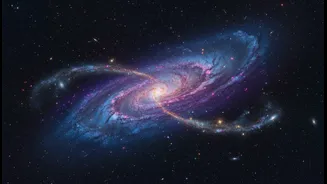
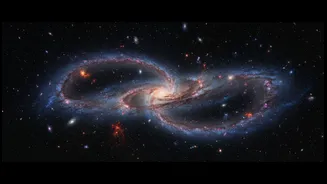
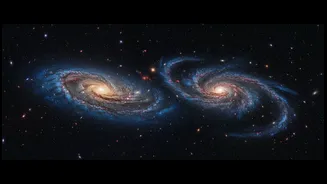
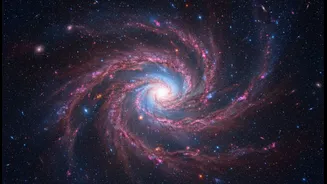
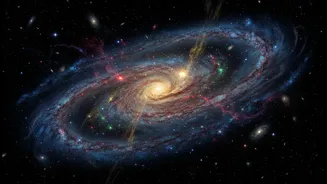
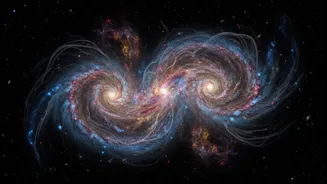
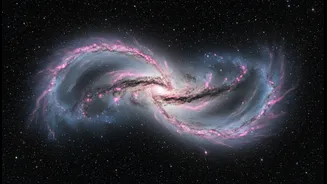
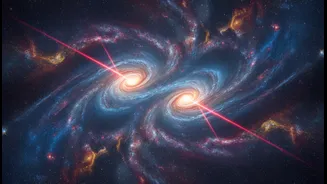
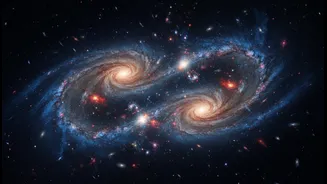
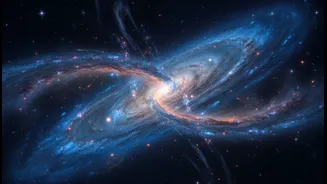
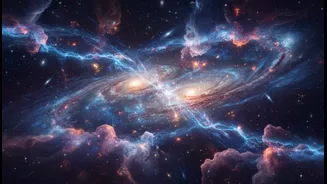
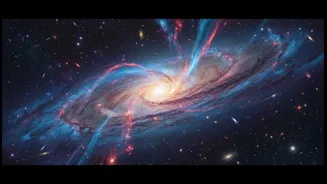
Computer-generated visuals and artists' impressions of galaxy collisions are a cornerstone of modern science communication. They depict vibrant, chaotic ballets where streams of stars are pulled apart like cosmic taffy. These images, often used in documentaries,
planetarium shows, and online articles, give us a snapshot of a process that is otherwise impossible to witness in a human lifetime. They make an abstract astronomical event feel immediate and spectacular. However, the very nature of compressing billions of years into a few seconds of animation means that key details are lost, and some crucial misconceptions are accidentally reinforced.
Misconception 1: It Is a 'Collision'
The word 'collision' itself is the first point of confusion. It suggests a violent, high-speed impact, like two cars crashing. The reality is far more subtle. When two galaxies merge, the individual stars within them almost never, ever collide. The reason is simple: a galaxy is mostly empty space. The distances between stars are so vast that even as two galaxies containing billions of stars pass through each other, the odds of any two stars actually hitting are practically zero. To put it in perspective, if the Sun were a ping-pong ball, its nearest star, Proxima Centauri, would be a pea over 1,000 kilometres away. The real interaction is gravitational. It's a slow, powerful tidal dance, not a demolition derby.
Misconception 2: It Happens in a Flash
Our visual media, from Hollywood films to science simulations, has trained us to expect rapid action. Galaxy collision animations often show the entire process unfolding in under a minute. In reality, these are among the slowest events in the universe. A full merger, from the first gravitational tugs to the final settling into a new, single galaxy, can take hundreds of millions, or even billions, of years. Our own Milky Way is on a course to merge with the Andromeda galaxy, but the main event won't even begin for another 4 to 4.5 billion years. The complete merger into a new galaxy, nicknamed 'Milkomeda', will take billions more years after that. What we see in simulations is a time-lapse of an almost unimaginably slow and graceful process.
What Really Happens: Gravity and Gas
If stars don't collide, what does? The primary actors in a galactic merger are gravity and gas. As two galaxies approach, their mutual gravity begins to distort their shapes, pulling out long streamers of stars and gas known as tidal tails. While the stars sail past each other, the vast clouds of interstellar gas and dust within each galaxy do slam into each other. This collision of gas clouds is monumental. It compresses the gas, triggering a massive wave of new star formation, an event known as a starburst. Far from being purely destructive, a galaxy merger is one of the universe's most powerful engines of creation, building millions of new stars and fundamentally reshaping galactic evolution.
How to Be a Smarter Space Fan
So, how can students and enthusiasts appreciate these amazing visuals without being misled? The key is to ask the right questions. When you see a simulation, look for a timescale. Is it explicitly stated that this process takes billions of years? Understand that the colours are often representative, not literal; for instance, blue often highlights areas of young, hot stars born in the merger, while red or yellow indicates older stars. Remember that you are watching a story of gravity's persistent influence over eons. The 'violence' is not in physical impacts but in the process of 'violent relaxation,' where stars' old, orderly orbits are scrambled into new, more random paths, often transforming two beautiful spirals into a single, larger elliptical galaxy.