
A New Record for the Oldest Light
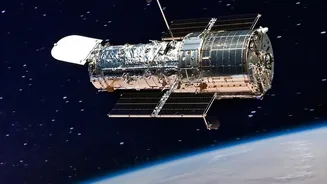
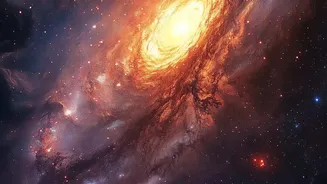
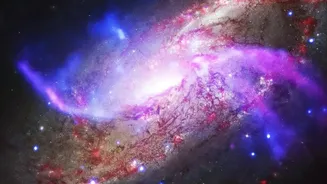
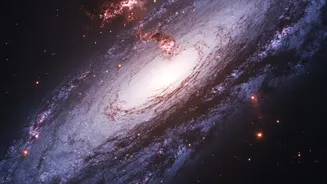
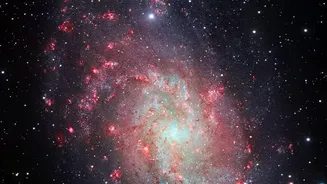
Astronomers are buzzing about a galaxy named MoM-z14. It may not have a catchy name, but it holds a monumental title: it is the most distant, and therefore earliest, galaxy ever confirmed by scientists. Thanks to the unparalleled power of the James Webb
Space Telescope (JWST), we are seeing MoM-z14 as it existed just 280 million years after the Big Bang. To put that in perspective, its light has traveled for over 13.5 billion years to reach us. For most of cosmic history, this galaxy was a ghost, its light too faint and stretched to be detected. But now, it has been brought into focus, giving us a direct view of the universe in its absolute infancy. This confirmation came from a dedicated study called the “Mirage or Miracle” survey, designed to verify the true nature of these extreme objects. And this one, it turns out, is a miracle.
An Unexpectedly Bright Beginning
The most startling thing about MoM-z14 isn't just its age; it's how surprisingly mature it looks. Cosmological models predicted that the first galaxies would be small, wispy, and simple structures. Instead, JWST keeps finding galaxies in the cosmic dawn that are remarkably luminous, complex, and more chemically enriched than they have any right to be. MoM-z14 is a prime example, shining with an intensity that baffles theorists. This isn't an isolated finding. Webb is consistently discovering that the early universe was far more active and capable of building large, bright galaxies much faster than previously believed. As one lead astronomer on the discovery team put it, what they're finding looks "nothing like what we predicted, which is both challenging and exciting."
The Power of Seeing in Infrared
This clearer picture is made possible by JWST's unique design. The telescope is a masterpiece of infrared astronomy. As the universe expands, the light from the most distant objects is stretched from visible and ultraviolet light into infrared wavelengths—a phenomenon known as redshift. Webb was built specifically to capture this ancient, stretched light. Furthermore, its spectroscopic instruments act like cosmic chemical labs, analyzing the light to confirm a galaxy's distance and composition with incredible precision. Before this, astronomers could spot candidates for early galaxies, but couldn't be sure they weren't closer objects masquerading as distant ones. With spectroscopy, JWST has provided the hard evidence, proving that these surprisingly advanced galaxies truly existed at the dawn of time.
Rewriting the First Cosmic Chapters
Each of these discoveries forces a major rethink of long-held theories. Finding so many bright, well-formed galaxies so early on creates a fascinating puzzle. How did the first stars ignite so quickly? How did galaxies organize themselves and grow so massive in such a short period? The gap between what the models predicted and what Webb is actually seeing is growing, suggesting there are fundamental aspects of galaxy formation we have yet to understand. These images are more than just pretty pictures; they are crucial data points that are sending cosmologists back to the drawing board. Scientists are now using this incoming flood of information to build new simulations that can account for this rapid early development, offering fresh insights into everything from the first stars to the mysterious role of dark matter in shaping the cosmos.