



The Sun's Hidden Fury
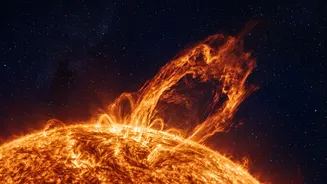
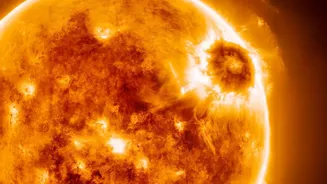
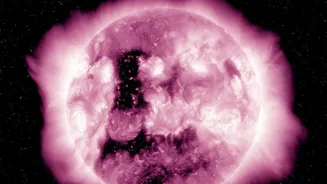
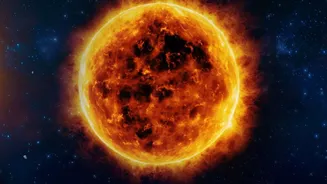
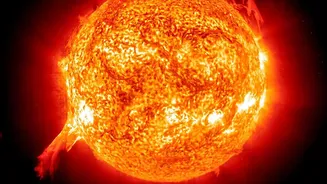
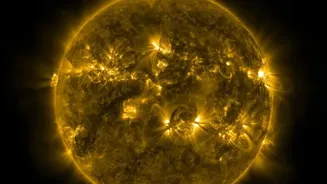
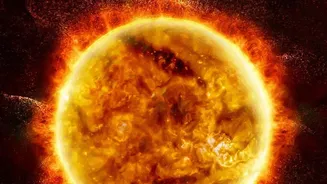
A solar storm is a major disturbance on the Sun that can send a torrent of energy and particles hurtling into space. These events can come in the form of solar flares—immense bursts of radiation—or coronal mass ejections (CMEs), which are giant clouds
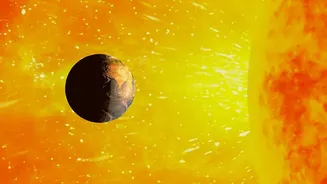
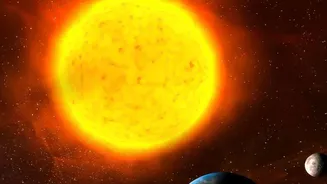
of solar plasma blasted from the Sun's atmosphere. When Earth is in the direct path of a powerful CME, our planet's magnetic field, which normally protects us, can be overwhelmed. This interaction creates what are known as geomagnetic storms, which can have serious effects not in space, but right here on the ground.
A Planet-Sized Problem
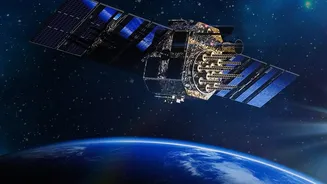
Our modern, tech-driven world is uniquely vulnerable to these geomagnetic storms. The induced electrical currents can flow into our power grids, potentially damaging high-voltage transformers and causing widespread, long-lasting blackouts. They can also disrupt high-frequency radio communications used by aircraft, interfere with GPS signals, and damage or even destroy the sensitive electronics of the thousands of satellites we rely on for everything from internet access and weather forecasting to financial transactions. In 1989, a solar storm knocked out power for millions in Quebec for hours; a much larger event in 1859, the Carrington Event, set telegraph stations on fire. A similar storm today could cause damage costing trillions.
Enter the AI Forecaster
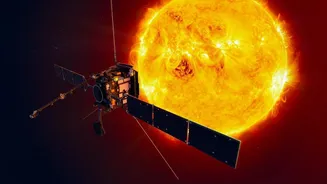
Until now, predicting exactly where and when a storm's impact would be felt has been a massive challenge. But that is changing thanks to a new tool. Researchers, through a NASA-partnered initiative, have developed an AI model called DAGGER (Deep Learning Geomagnetic Perturbation). This system was trained using deep learning, analysing vast amounts of data from NASA's solar-monitoring spacecraft. It learned to spot the connections between the solar wind—the stream of particles constantly flowing from the Sun—and the resulting geomagnetic disturbances on Earth.
A Crucial 30-Minute Warning
The result is a game-changer. DAGGER can predict the specific location and severity of a geomagnetic disturbance anywhere on Earth with a 30-minute advance warning. While half an hour might not sound like much, it is a critical window of opportunity. It's enough time for power grid operators to re-route power or take transformers offline, for satellite controllers to put spacecraft into a protective safe mode, and for airlines to divert flights that might be affected by communication or navigation outages. The system can generate a global forecast in less than a second and updates it every minute, providing a real-time 'space weather siren'.
What This Means For India
For a rapidly digitizing nation like India, this technology is especially significant. With our deep reliance on satellites for communication, a burgeoning digital economy, and a vast and interconnected power grid, the potential disruption from a solar storm is immense. The lead author of the paper on DAGGER, Vishal Upendran, is from the Inter-University Center for Astronomy and Astrophysics in India, highlighting the global nature of this research. This AI-driven warning system can help protect India's critical infrastructure, from the UPI payment network that depends on stable connectivity to the power grids that light our homes and cities. As our own space ambitions grow with ISRO's missions, the ability to forecast space weather becomes even more vital for protecting our assets in orbit.