



The High Cost of Throwaway Rockets
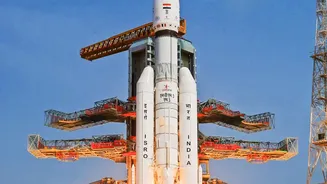
Traditionally, sending anything to space has been a one-shot deal. A massive, expensive rocket blasts off, deploys its payload, and its valuable components are discarded, burning up in the atmosphere or falling into the ocean. It’s like building a brand-new
car for a single trip and then throwing it away. The structure of the launch vehicle itself accounts for the vast majority of the mission's cost, with some estimates suggesting it's around 80% of the total expense. The fuel, or propellant, is a comparatively small fraction of the bill. This single-use model has kept space access expensive and limited, acting as a major barrier to more ambitious space exploration and utilisation. For India to become a bigger player in the global space economy, which is projected to exceed a trillion dollars by 2035, finding a way to slash these costs is critical.
Enter Pushpak: India's Space Shuttle
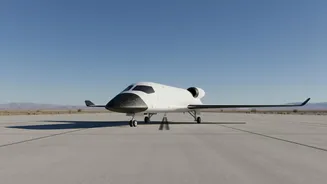
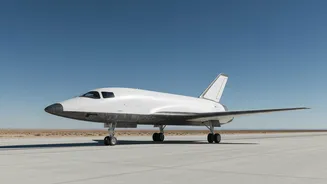
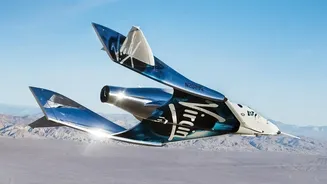
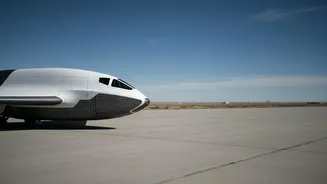
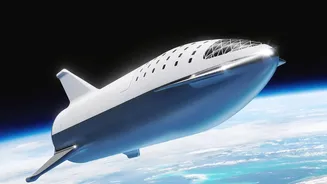
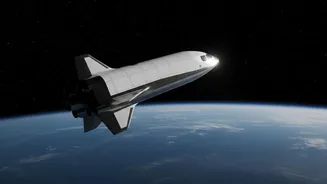
ISRO's answer to the cost problem is the Reusable Launch Vehicle, or RLV. Nicknamed 'Pushpak', this advanced winged vehicle is at the heart of the agency's strategy to make space launches more economical. Unlike the vertical-landing boosters used by companies like SpaceX, ISRO's Pushpak is designed to function more like a space plane. The concept involves a vehicle that takes off vertically like a rocket and, after its mission, re-enters the atmosphere and lands horizontally on a runway, just like an aircraft. This reusability is the key. By recovering and refurbishing the most expensive parts of the launch system, ISRO aims to dramatically reduce the cost of each subsequent mission. The long-term goal is to bring down launch costs by a significant margin, potentially by as much as 80 percent.
Proving the Technology: The Landing Experiments
Before Pushpak can fly to orbit, ISRO must perfect the most challenging part of its journey: the autonomous landing. To do this, the agency has been conducting a series of Landing Experiments (LEX). In these crucial tests, the winged vehicle is carried to a high altitude by an Indian Air Force Chinook helicopter and then released. From there, Pushpak is on its own. It must autonomously navigate its way to a runway, manage its high speed, and execute a precise landing. The latest test, the third in the LEX series, successfully demonstrated this capability under even more challenging wind conditions and from a greater distance than previous attempts. During the landing, Pushpak reached speeds over 320 kmph before using a brake parachute and its landing gear brakes to come to a controlled stop. These successful tests prove that ISRO has mastered the critical technologies for autonomous navigation, control, and landing needed for a space-returning vehicle.
The Economic Domino Effect
The success of the RLV program has far-reaching economic implications. By drastically lowering launch costs, India can offer more competitive satellite launch services on the global market, a sector already worth billions. Cheaper access to space also stimulates domestic innovation, enabling more universities, startups, and research institutions to send their own experiments and satellites into orbit. Furthermore, mastering this technology paves the way for future advancements, including more complex space exploration missions, satellite servicing, and even space tourism. The development of a fully reusable launch vehicle could make Indian launch services the most cost-effective in the world, combining advanced technology with the nation's existing advantages in low-cost manufacturing. This positions India not just as a participant but as a potential leader in the new space race, which is increasingly defined by economic efficiency.
The Road Ahead for ISRO's RLV
The successful completion of the landing experiments is a monumental achievement, but the journey is far from over. These tests are part of a phased technology demonstration program. The next steps will involve scaling up the vehicle and conducting more complex experiments, including hypersonic flight tests and eventually an orbital re-entry experiment (ORE). The ORE will see a vehicle launched into orbit, where it will spend some time before re-entering the atmosphere and landing on a runway. Developing a fully operational Two-Stage-To-Orbit (TSTO) vehicle is a long-term vision that will take many more years of dedicated work. However, with each successful test, ISRO moves one step closer to its goal of providing reliable, on-demand, and low-cost access to space, securing India's place among the world's leading space-faring nations.