





Beyond the Event Horizon
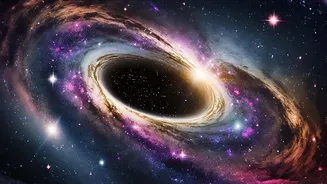
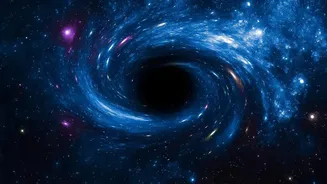
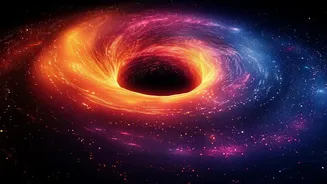
A black hole is an object so massive and dense that its gravitational pull is inescapable, even for light. But not all black holes are dormant. The most spectacular are 'active' black holes, officially known as Active Galactic Nuclei (AGN). These are supermassive
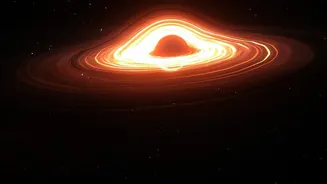
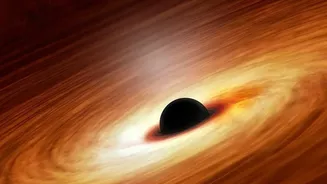
black holes, millions or billions of times the mass of our sun, that are in the process of feeding. They are surrounded by a swirling disk of superheated gas and dust called an accretion disk. As this material spirals inward, friction heats it to extreme temperatures, causing it to glow so brightly it can outshine all the stars in its host galaxy combined. This intense activity makes them some of the most luminous objects in the cosmos and crucial laboratories for understanding extreme physics.
The Cosmic Power Plant
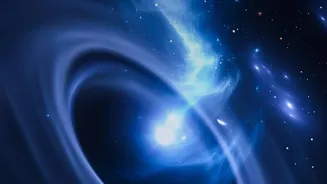
The central mystery has always been how these black holes convert gravitational energy into other forms, like powerful jets of plasma that shoot out at nearly the speed of light. These jets can extend for hundreds of thousands of light-years, influencing star formation and the evolution of their entire galaxy. For years, scientists theorised that magnetic fields were the key. The idea, known as the Blandford-Znajek process, proposed that a black hole's spin could twist magnetic fields, extracting energy and channelling it into these jets. But observing this in action, and understanding the details, has been a monumental challenge.
A Breakthrough in Understanding
Recent findings, synthesizing over a decade of observations from various radio and X-ray telescopes, have provided the clearest picture yet of this energy exchange. It's not a simple, steady process. Instead, the heart of an active black hole is a turbulent and violent place. The key interaction is between the intensely hot plasma of the accretion disk and the powerful magnetic fields that thread through it. New, high-fidelity computer simulations have been crucial in making sense of long-archived data, revealing a process called 'magnetic reconnection'. This is where magnetic field lines within the plasma snap and violently reconfigure, releasing enormous amounts of energy in the form of heat and light, much like a solar flare on the Sun, but on an unimaginable scale.
The Dance of Plasma and Magnetism
This research confirms that the accretion disk is not just fuel, but an active participant in the energy extraction. As the disk material gets closer to the black hole, instabilities cause the magnetic fields to become tangled and amplified. This magnetic turbulence is what drives the reconnection events, which in turn heat the disk and power the outward flow of energy. Furthermore, studies have shown a direct link between changes in the accretion disk and the launch of jets. When the inner edge of the gas disk rapidly shrinks closer to the black hole, it triggers the eruption of a plasma jet. This suggests a dynamic feedback loop: the black hole's gravity pulls matter in, the matter's motion amplifies magnetic fields, and the magnetic fields then expel energy and matter back out.
Rewriting the Cosmic Rulebook
These discoveries, built on years of patient observation and advanced modelling, are transforming our view of the role black holes play in the cosmos. They are not just passive sinks of matter but are intricately connected to their host galaxies through a complex cycle of accretion and feedback. The energy they blast out can 'kill' a galaxy by blowing away the gas needed for star formation, or in other cases, trigger the collapse of gas clouds to form new stars. By finally understanding the mechanics of this cosmic engine, astronomers can better model how galaxies evolve over billions of years and paint a more complete picture of the universe's large-scale structure.