






NASA's journey back to the Moon is taking a crucial, calculated detour through Earth orbit. The Artemis III mission, now targeting a 2027 launch, has been reshaped into a vital dress rehearsal instead of an immediate lunar landing.
What Is the New Artemis III Mission?
Originally planned as
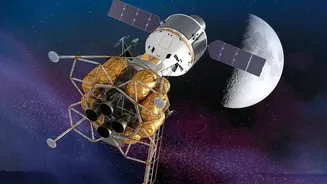
the mission to return astronauts to the lunar surface for the first time since Apollo 17, Artemis III has been repurposed. It will now be a complex demonstration flight in low Earth orbit, planned to last approximately two weeks. A crew of four astronauts will launch aboard the Orion spacecraft and, for the first time, practice rendezvous and docking procedures with test versions of the human landing systems being developed by SpaceX and Blue Origin. This mission is designed as a full-scale systems check, moving the first lunar landing of the 21st century to the Artemis IV mission, which is scheduled for 2028.
A Complex Orbital Ballet
The mission will be an unprecedented logistical exercise involving three separate launches. First, Blue Origin will launch a test version of its Blue Moon lander on a New Glenn rocket. Days later, the Artemis III crew will launch in the Orion capsule atop the powerful Space Launch System (SLS) rocket. The crew will rendezvous and dock with the Blue Moon vehicle, and astronauts are expected to enter the lander's crew cabin to evaluate its life support systems and controls for about two days. After undocking, SpaceX will launch a test article of its Starship lander. The Orion will then perform a second rendezvous and docking, this time with the Starship, to test software integration and control of the combined spacecraft, though the crew will not enter the Starship on this flight.
Why the Change in Plans?
The shift in strategy is all about reducing risk. Attempting to dock two brand-new, massive spacecraft for the first time in deep space, hundreds of thousands of miles from home, carries immense risk. Testing these critical procedures in the relative safety of low Earth orbit provides a vital safety net. If any issues arise with docking mechanisms or life support systems, the crew is only hours away from a safe return to Earth, as opposed to the several days it would take from lunar orbit. NASA has compared the mission to Apollo 9, which famously tested the Lunar Module in Earth orbit before it was used to land on the Moon. This 'practice run' allows engineers to gather crucial data and validate hardware before committing astronauts to a lunar landing.
The Key Hardware Being Tested
Artemis III will be the first integrated flight test for the Orion spacecraft and the two commercial Human Landing System (HLS) providers. The landers flown will be 'test articles' or 'pathfinders'—not the final versions equipped for a lunar landing. Blue Origin's vehicle will feature a functional crew module and life support systems for the astronauts to test. SpaceX's test article will be a modified Starship V3 fitted with a docking adapter on its nose, focusing on the dynamics of linking with Orion and controlling the combined stack. The mission provides a crucial opportunity to see how Orion interacts with both lander designs from two different commercial partners.
What This Means for the Moon Landing
While this change pushes the first crewed lunar landing to Artemis IV in 2028, it is seen as a necessary step to ensure the longterm success and safety of the Artemis program. By derisking the complex docking and habitation elements in 2027, NASA can proceed to the lunar surface with much higher confidence. This demonstration mission allows the agency and its partners to learn how the Orion, the crew, and ground teams all interact with any new hardware from both lander providers before sending astronauts to any Moons surface. It keeps program momentum moving forward, allowing NASA to fly any hardware that is ready while other components, like any full landing systems, are finalized.