





A Telescope on a Global Scale
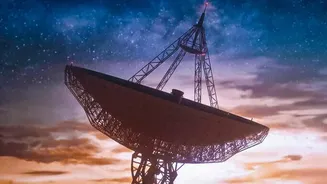
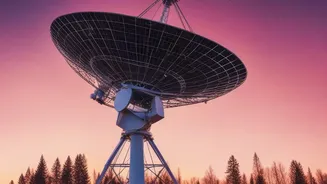
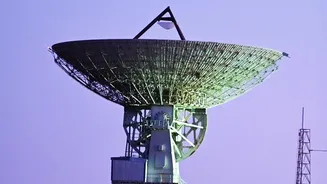
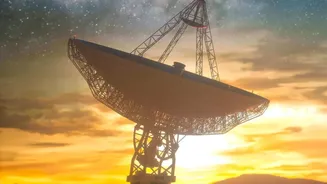
The Square Kilometre Array (SKA) isn't a single telescope but a globe-spanning network of thousands of antennas. It is an international mega-science project with its headquarters in the UK and two distinct telescope sites in South Africa and Australia.
India is a full member of the project, contributing ₹1250 crore and providing crucial software expertise, particularly in developing the telescope's complex monitor and control system—its 'brain and nervous system'. This involvement, led by institutions like the National Centre for Radio Astronomy (NCRA) in Pune, builds on India's long legacy in radio astronomy, including the pioneering Giant Metrewave Radio Telescope (GMRT). Construction on the SKA began in late 2022 and is expected to be complete by 2029, with early science operations already beginning to yield results.
The Science of Unmatched Sensitivity
In radio astronomy, sensitivity is everything. It is the ability to detect incredibly weak signals. The SKA's sensitivity will be unparalleled, making it about 50 times more powerful than any existing radio instrument. This power comes from a technique called interferometry, which combines the signals from many smaller antennas to act as one enormous virtual telescope. The more antennas you have, the larger the effective 'collecting area' for cosmic signals, allowing you to pick up fainter details. The SKA-Low telescope in Australia will eventually have 131,072 antennas, while the SKA-Mid in South Africa will have 197 large dishes. This vast collecting area is what allows the SKA to detect cosmic whispers that are completely invisible to other telescopes.
How It Achieves This Power
The SKA's sensitivity is a product of both immense scale and cutting-edge design. The antennas are spread out over vast distances—up to 150 km in South Africa and 74 km in Australia. This large separation, known as a long baseline, allows the telescope to achieve extremely high resolution, producing sharper images than a single large dish ever could. The Australian site uses deceptively simple-looking 'Christmas tree' antennas designed to be highly efficient at the low frequencies needed to study the early universe. The signals from all these antennas are synchronised with extreme precision and then combined in powerful supercomputers, which process a flood of data so immense it would fill the storage of a typical laptop in seconds.
Hunting for the Universe's First Light
One of the SKA's primary missions is to observe a period known as the 'Cosmic Dawn', the era just a few hundred million years after the Big Bang when the very first stars and galaxies began to form. Before this, the universe was filled with a fog of neutral hydrogen gas. This hydrogen emitted a faint radio signal with a specific wavelength (21cm), which has been stretched by the expansion of the universe to longer, lower-frequency wavelengths today. The signal is thousands of times fainter than the radio noise from our own galaxy, but the SKA-Low telescope is specifically designed to filter out this noise and detect that elusive signature from the dawn of time, allowing us to map the structure of the early universe for the first time.
Mysteries It Could Solve
Beyond the Cosmic Dawn, the SKA's sensitivity opens a new window onto many other cosmic mysteries. It will be an unparalleled tool for detecting Fast Radio Burst (FRBs), millisecond-long blasts of energy from unknown sources across the cosmos. By studying how these bursts are altered as they travel through space, scientists can weigh the universe's matter, test Einstein's theory of General Relativity, and even search for signs of ultralight dark matter. The telescope will also be able to map the magnetic fields of galaxies, study pulsars with extreme precision, and scrutinise the gas clouds where new stars and planets are born. Its power may even be sufficient to detect faint technological signals from extraterrestrial civilisations, if they exist.