




Meet the Cosmic Victim
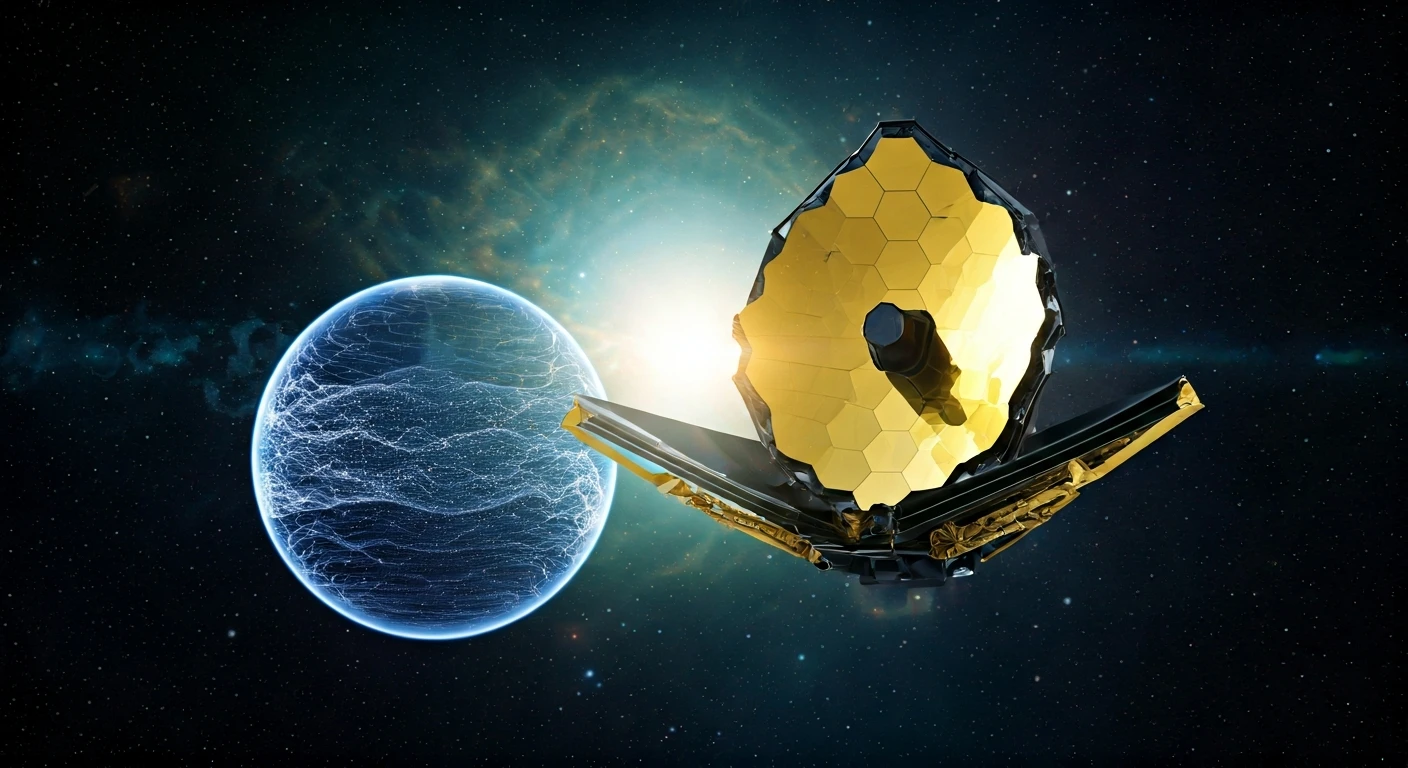
The planet at the center of this dramatic celestial event is HD 209458 b, a gas giant sometimes informally known as Osiris. Located about 157 light-years away, it's a type of world astronomers call a 'hot Jupiter'. These are gas giants, similar to our
own Jupiter, but they orbit their stars at an extremely close distance. In the case of Osiris, it hugs its sun-like star at a distance of just 7 million kilometers, completing a full orbit—its 'year'—in a mere 3.5 Earth days. This perilous proximity means the planet is constantly bathed in intense radiation, heating its surface to an estimated 1,000 degrees Celsius. While its mass is less than Jupiter's, its blistering temperature has caused its atmosphere to puff up, making it significantly larger in volume. This bloated state makes it particularly vulnerable to its star's relentless energy.
What 'Getting Cooked' Really Means
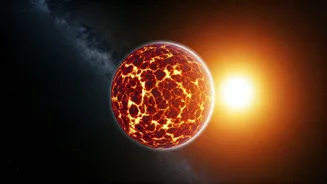
The phrase 'getting cooked' is a rather dramatic but apt description for a scientific process called photoevaporation. This occurs when a planet's atmosphere is blasted by high-energy photons, particularly ultraviolet radiation, from its host star. These photons heat the gases in the upper atmosphere, energizing them to the point where they can overcome the planet's gravitational pull and escape into space. Essentially, the star is boiling away the planet's atmosphere layer by layer. Lighter gases like hydrogen and helium are the most susceptible to this process, as they can reach escape velocity more easily. For planets like HD 209458 b, which are already hot and have a huge, extended atmosphere, photoevaporation can be incredibly powerful, stripping away vast quantities of mass over millions of years.
Webb's Unprecedented Evidence
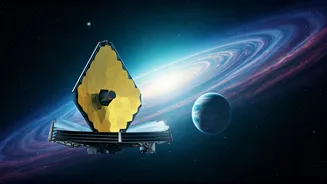
While astronomers have long theorized about atmospheric escape, the James Webb Space Telescope (JWST) has provided the most detailed look at this process to date. By observing HD 209458 b as it passed in front of its star, a technique known as transit spectroscopy, Webb was able to analyze the starlight filtering through the planet's atmosphere. The data was unequivocal. Webb detected a massive, comet-like tail of gas, primarily hydrogen and helium, streaming away from the planet. This confirmed that the planet is losing its atmosphere at a significant rate. Previous observations with the Hubble Space Telescope had hinted at this, but Webb's superior sensitivity allowed it to not only confirm the escaping hydrogen but also detect heavier elements like carbon and oxygen being dragged away in the flow, painting a vivid picture of a world actively being eroded by its star.
Solving a Cosmic Mystery
Studying planets like HD 209458 b isn't just about witnessing a cosmic spectacle; it helps solve a major puzzle in astronomy known as the 'hot Neptune desert'. Astronomers have noticed a strange lack of Neptune-sized planets in very close orbits around their stars. They find plenty of scorching hot, Jupiter-sized planets and smaller, rocky 'super-Earths', but the intermediate-sized worlds are conspicuously missing. One leading theory is that this 'desert' exists because planets that start as hot Neptunes are stripped of their gaseous atmospheres by intense stellar radiation over time. This process of photoevaporation would leave behind only their dense, rocky cores, transforming them into super-Earths. By catching a larger gas giant in the act of being stripped, Webb's observations provide strong evidence for this theory, suggesting we are watching a process that could explain the mysterious planetary gap.