


First, A Quasar Refresher
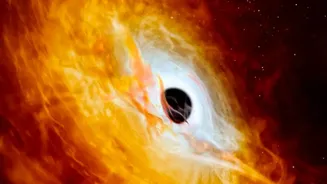
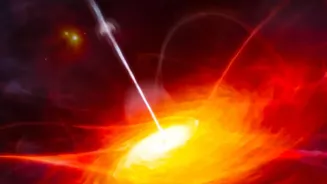
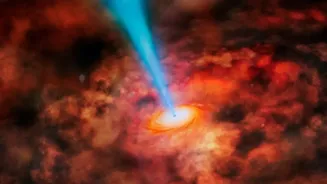
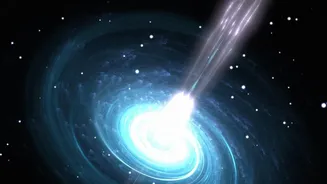
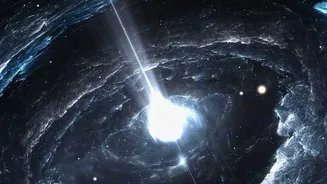
Before diving into the deep end of the cosmic pool, let's talk about quasars. Short for 'quasi-stellar radio source', a quasar is essentially a cosmic engine of incredible power. At its heart is a supermassive black hole, millions or even billions of times
the mass of our Sun, that is actively feeding on a surrounding whirlpool of gas and dust. As this material gets pulled in, intense friction and gravitational forces cause it to heat up and glow with unimaginable brightness, often outshining its entire host galaxy. Because they are so luminous, quasars act as cosmic lighthouses, allowing astronomers to spot them from across the universe and use them to study the conditions of the cosmos when it was very young.
A Record-Breaking Pair at Cosmic Dawn
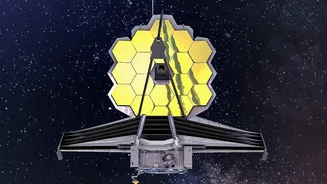
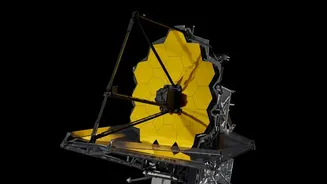
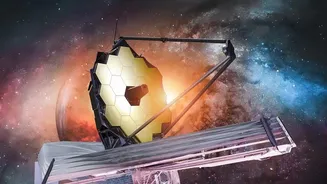
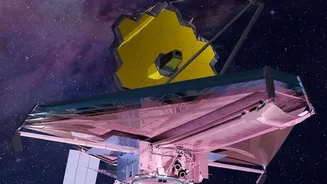
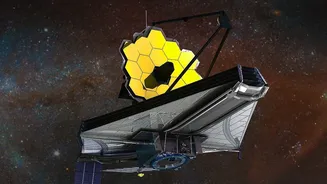
The headline discovery involves a system nicknamed Nāpōwawāʻenakaulua, spotted by JWST and confirmed with the Gemini North telescope in Hawai'i. This isn't just one quasar, but two, seen as they were just 900 million years after the Big Bang. Finding a pair of quasars from this early 'cosmic dawn' era is unprecedented. What's more, they are incredibly close to each other, separated by only about 18,100 light-years—a fraction of the Milky Way's diameter. This makes them the most compact quasar pair ever found from this period in the universe's history.
A Problem of Impossible Size
Here’s the puzzle that has astronomers scratching their heads: the sheer size of these black holes. The two quasars in Nāpōwawāʻenakaulua are powered by black holes weighing about 1.5 billion and 400 million times the mass of the Sun, respectively. According to our current understanding of cosmic evolution, black holes need a lot of time—at least a billion years—to grow to such monstrous sizes by gradually consuming matter and merging with other black holes. Finding not just one, but two of these behemoths so close together, so early in the universe, directly challenges these models. As one researcher put it, there is no definitive theoretical explanation for how even one of these giant quasars could exist so early, let alone two.
More Than Just a One-Off Find
The discovery of this quasar pair isn't happening in isolation. JWST's incredible sensitivity has been consistently finding supermassive black holes that are 'too big, too early'. The Cosmic Evolution Early Release Science (CEERS) Survey, for example, has used Webb to identify multiple black holes from the universe's first billion years. These include CEERS 1019, the most distant active supermassive black hole found to date, which existed just 570 million years after the Big Bang. While smaller than the Nāpōwawāʻenakaulua pair, its early existence also poses a similar challenge to formation theories. Finding multiple quasars in compact regions or in pairs suggests that the environments that foster rapid black hole growth might have been more common than previously thought, possibly fueled by frequent galaxy mergers in the dense, early universe.
Rewriting the Cosmic Playbook
These findings force scientists to reconsider the fundamental processes of galaxy and black hole formation. The existence of these ancient, massive quasar pairs suggests that black holes may not have grown from small 'seeds' as slowly as believed. Instead, they may have formed from much larger initial black holes or experienced periods of extremely rapid, super-efficient feeding that our current models don't account for. The fact that Nāpōwawāʻenakaulua was found in a survey that has already identified 200 early quasars indicates these objects may not be complete outliers. This 'quasar pair' could be a signpost of an incredibly dense region of the early cosmic web, a natural laboratory for studying how the universe's first massive galaxies came together.