


What Is a Conjunction and When to Watch
In astronomical terms, a conjunction occurs when two or more celestial bodies appear close to one another in the sky from our vantage point on Earth. This October, the Moon and Saturn will have their moment. The conjunction will be visible over several
days, but the closest approach will be the highlight. Skywatchers in India should mark their calendars for the evening of October 24, 2026. This is when the Moon and Saturn will appear as a beautiful pair after sunset. While they look close, they are, of course, separated by an enormous distance in space. The days surrounding this date, from October 21 to 24, will also offer lovely views as the waxing gibbous Moon journeys past the ringed planet.
Finding the Perfect Viewing Spot
Your location is as crucial as your camera. To get the best possible shot, you need to escape the glare of city lights. Light pollution can wash out the fainter light of Saturn and reduce the contrast of your image. Find a spot with a clear, unobstructed view of the southeastern horizon. Parks, rural areas, or even designated dark-sky locations are ideal. In India, Saturn will rise around sunset and be visible for most of the night throughout October, having reached its brightest point for the year earlier in the month on October 4. Give your eyes about 20-30 minutes to adapt to the darkness to better spot your celestial targets.
Essential Gear for Celestial Photography
While you can spot the conjunction with the naked eye, photographing it requires some specific gear. A DSLR or mirrorless camera that allows manual control is essential. You'll also need a sturdy tripod to keep your camera perfectly still during the exposure, preventing blurry images. For lenses, you have two main options. A wide-angle lens (14-35mm) will let you capture the conjunction along with a scenic foreground, like a treeline or a lake, which can add scale and context to your photo. A telephoto lens (200mm or longer) is necessary if you want a tighter shot of the Moon and Saturn, making them appear larger in the frame. A remote shutter release or using your camera’s built-in timer will also help avoid camera shake.
Camera Settings for the Perfect Shot
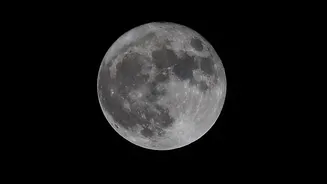
Getting the exposure right is key, as the Moon is very bright compared to Saturn. Start with your camera in Manual (M) mode. Set your focus manually to infinity, then use your camera's live view zoomed in on the Moon to fine-tune it for maximum sharpness. A good starting point for your settings is a low ISO (100-400), a mid-range aperture (around f/8), and a shutter speed between 1/100s and 1/250s. These settings work well for capturing detail on the sunlit Moon. However, Saturn is much dimmer, so you may need to experiment. Taking multiple shots with different settings (a practice called 'bracketing') is a great strategy. One shot exposed for the Moon, and another with a longer shutter speed (a few seconds) to capture Saturn and any surrounding stars. These can be blended later. Always shoot in RAW format to have the most flexibility during post-processing.
The Art of Framing Your Shot
A great astrophoto tells a story. Don't just point your camera at the sky; think about your composition. Use a wide-angle lens to include an interesting foreground element. A silhouette of a mountain range, an old building, or reflections in a body of water can transform a simple snapshot into a breathtaking photograph. Pay attention to where the Moon and Saturn are in your frame. The 'rule of thirds' is a useful guide. Instead of placing them dead center, try positioning them off to one side to create a more dynamic and visually appealing image. Capturing the scene just after sunset can also add beautiful colours to the sky, providing a stunning backdrop for the celestial pair.