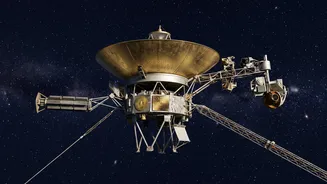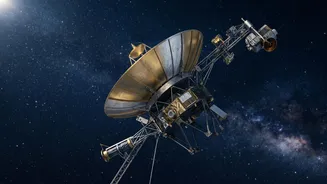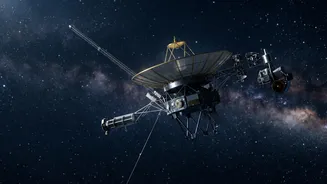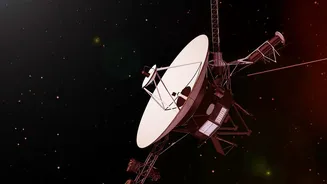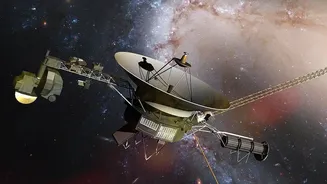



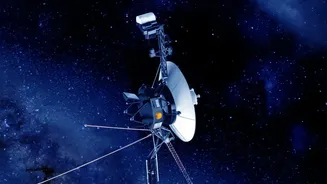
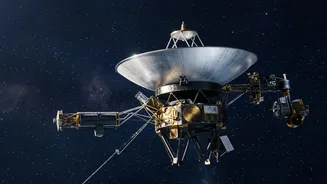
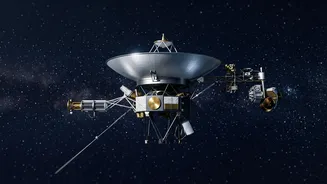
Humanity’s farthest-flung emissary, the Voyager 1 spacecraft, gave its creators a scare last month, falling silent for 48 hours. Then, just as mysteriously, it came back online, leaving engineers at NASA both relieved and astonished.
A Signal from the Void
On October 18 and
19, mission controllers at NASA’s Jet Propulsion Laboratory (JPL) held their breath. During two scheduled communication attempts, the agency’s powerful Deep Space Network received nothing but silence from Voyager 1. For 48 tense hours, the line to our most distant robotic explorer was dead. Then, on October 20, a signal reappeared. Before the engineering team could even begin sending diagnostic commands across the vastness of space, Voyager 1 had, in essence, healed itself. This marked the first time the nearly 50-year-old probe has corrected such a fault without any direct human intervention.
The Ghost in the Machine
So, what happened out there in the interstellar dark? Early analysis suggests the spacecraft's onboard fault protection software did exactly what it was designed to do. Engineers believe that one set of the probe's attitude-correction thrusters—tiny engines that keep its main antenna pointed at Earth—went offline. In response, the spacecraft's autonomous systems automatically switched to a backup set of thrusters, placed itself in a stable 'safe mode', and then re-established contact. While the procedure itself is programmed, the fact that it resolved the communication loss without a prompt from Earth was a surprise. 'This is the first time we've seen the spacecraft do something like this', said Kareem Badaruddin, Voyager mission manager at JPL, adding that at this stage of the mission, they 'have to expect the unexpected'.
Humanity’s Farthest Emissary
Launched in 1977, Voyager 1 and its twin, Voyager 2, were initially designed for a five-year mission to study Jupiter and Saturn. But they just kept going. Voyager 1 flew past Jupiter in 1979 and Saturn in 1980 before its trajectory sent it hurtling toward the edge of the solar system. In 2012, it made history by becoming the first human-made object to enter interstellar space—the region between the stars. For nearly 50 years, this resilient probe has been our lone scout in the cosmic ocean, sending back invaluable data about an environment no other craft has ever explored. It's so far away that it will soon reach another incredible milestone: on November 18, 2026, it will be one light-day from Earth, a distance of nearly 26 billion kilometres.
Diagnosing from Billions of Kilometres Away
The November 18 milestone highlights the immense challenge of operating the aging probe. At a distance of one light_day, a radio signal traveling at the speed of light takes a full 24 hours to reach the spacecraft. Any reply or data sent back takes another 24 hours to return. This 48_hour round_trip communication delay makes real_time troubleshooting impossible. The 'self_repair' incident underscores the remarkable foresight of its 1970s_era engineers, who built in autonomous systems capable of handling unexpected problems when the home world is too far away to help quickly. While the exact cause of the thruster issue is still under investigation, the successful recovery is a testament to the probe's robust design.
The Long Road Ahead
This recent drama occurred just weeks after engineers performed a clever power_saving manoeuvre nicknamed the 'Big Bang'. The probe is powered by a plutonium_based generator that loses about four watts of power each year. To extend the life of its scientific instruments, the team swapped several power_hungry heaters for more efficient alternatives. This upgrade is expected to delay the next instrument shutdown until at least 2027, allowing Voyager $1$ to continue studying the interstellar medium. Despite its age and the immense distances, the mission continues. Contact has remained stable since the brief outage, and the team at NASA remains focused on squeezing every last drop of science from this legendary explorer.