





A Lighthouse in the Cosmos
Imagine a star more massive than our sun, collapsed into a city-sized sphere, spinning faster than a helicopter's rotor. This is a pulsar, a type of neutron star. They are the incredibly dense remnants of massive stars after a supernova explosion. What
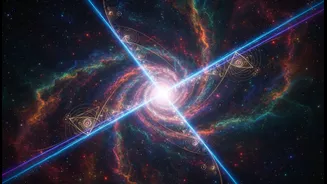
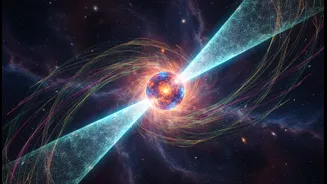
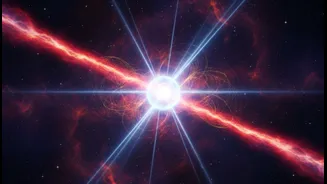
makes them 'pulsars' is their powerful magnetic field, which funnels beams of energy and particles from its poles. As the star spins, these beams sweep through space like a cosmic lighthouse. When one of these beams points toward Earth, our telescopes see a regular pulse of light, giving the object its name.
The Vela Pulsar and Its Jet
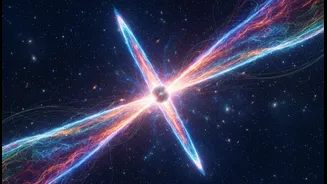
One of the most famous of these celestial beacons is the Vela Pulsar, located about 1,000 light-years from Earth. It spins more than 11 times per second, and in doing so, it unleashes a tremendous amount of energy. This energy creates a vast cloud of charged particles and magnetic fields known as a pulsar wind nebula. Flowing from this nebula is a remarkable structure: a narrow, focused jet of high-energy particles shooting out into space at about half the speed of light. For years, scientists have studied this jet, seen in colourful X-ray images from telescopes like NASA's Chandra X-ray Observatory, but a key question remained: what shapes and powers this incredible cosmic firehose?
Mapping the Unseen Force
The answer lies in a force that we can't see directly: magnetic fields. To understand their role, NASA turned to a specialised tool, the Imaging X-ray Polarimetry Explorer, or IXPE. Unlike telescopes that just capture the brightness and colour of light, IXPE measures its polarization. Polarization tells scientists about the orientation of the light waves. Because high-energy particles are guided by magnetic fields when they emit X-rays, measuring the polarization of those X-rays allows astronomers to create a map of the underlying magnetic field structure. It's a way of making the invisible, visible.
The Magnetic Blueprint Revealed
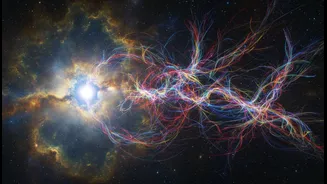
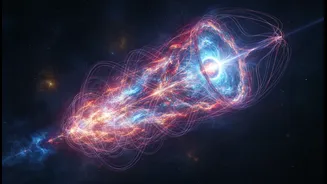
Recent observations of a similar object, nicknamed the Lighthouse Nebula, have confirmed what scientists long suspected. By pointing IXPE at the pulsar for nearly 18 days, astronomers were able to map its magnetic field with incredible precision. The results showed a highly organised magnetic field that acts like a scaffold, guiding charged particles away from the pulsar. The field confines the particles, preventing them from spreading out and instead channelling them into a tight, powerful jet. This process is similar to how a nozzle shapes a stream of water, turning a wide flow into a powerful, directed spray. This observation confirmed that these organised magnetic fields are the engine behind the formation of these spectacular jets.
A Cosmic Rosetta Stone
Understanding the magnetic field of one pulsar does more than just solve a single puzzle. These objects are natural laboratories for studying physics under conditions far more extreme than anything we can create on Earth. The mechanisms that create jets in pulsar wind nebulae are thought to be similar to those that form even more powerful jets erupting from the regions around supermassive black holes at the centres of galaxies. By studying a relatively close and clear example like the Vela or Lighthouse pulsars, scientists can refine their models of particle acceleration and jet formation that apply across the cosmos. IXPE's ability to map these magnetic 'bones' of the universe gives us a new and essential tool for understanding how its most dramatic structures are built.