



A Signal from a Stellar Nursery
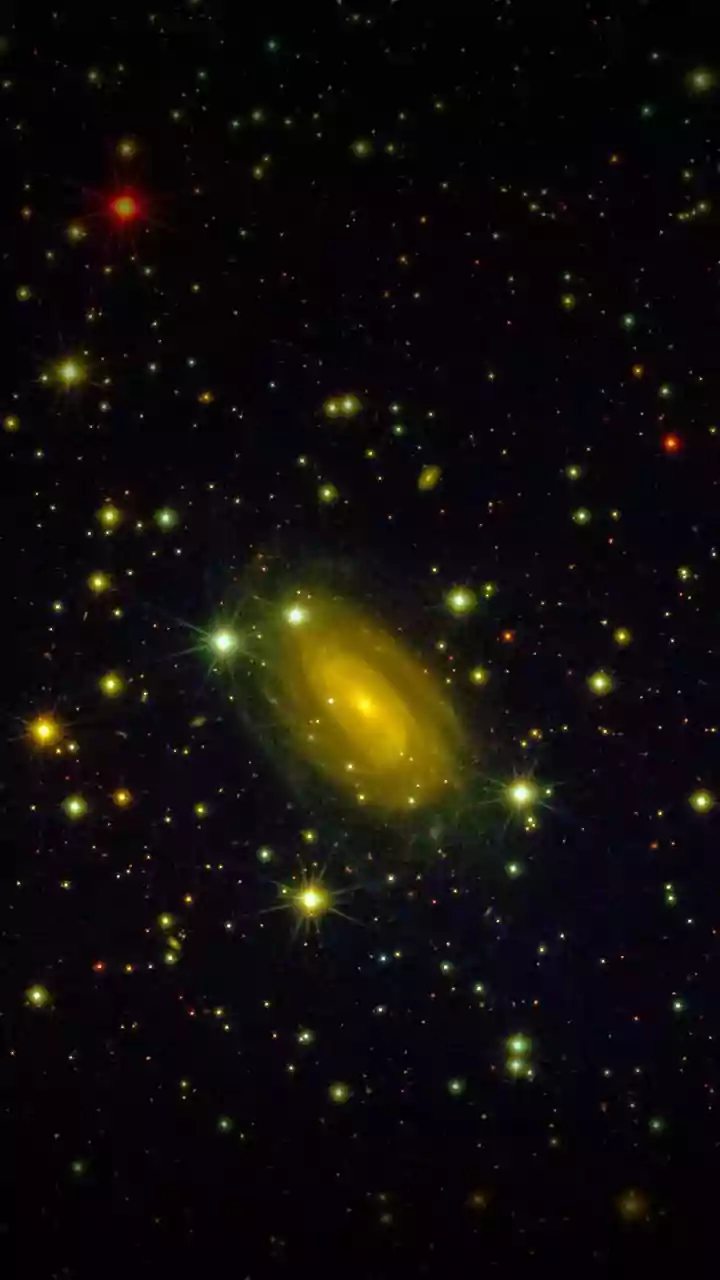
An international team of scientists, led by astrochemist Izaskun Jiménez-Serra, pointed powerful radio telescopes in Spain toward a massive, dense cloud of gas and dust some 27,000 light-years away. This region, known as G+0.693−0.027, is a stellar nursery,
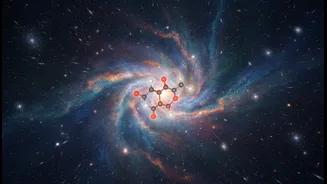
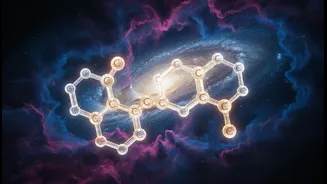
a place where new stars and planets are born. By analyzing the faint radio signals, they identified the unmistakable signature of erythrulose, a four-carbon sugar. While simpler organic molecules have been found in space before, this marks the first direct detection of a true sugar—a molecule with at least three carbon atoms—in the interstellar medium. It proves that molecules crucial for biology can exist in the cold, harsh environment of space, long before they might land on a planet.
Not Just Any Sugar
Erythrulose is more than a cosmic curiosity. It's considered a prebiotic molecule, a chemical precursor to the building blocks of life. Sugars are fundamental to biology as we know it; they form the structural backbone of RNA and DNA and are essential for metabolic processes. The mystery has always been how Earth got its sugars, as lab experiments suggest they wouldn't have formed in large enough quantities on the early planet itself. The detection of erythrulose in space reinforces the theory that these vital ingredients were delivered to a young Earth by comets and asteroids. Even more, scientists note that erythrulose can, in the presence of water, transform into other important sugars like threose, a molecule considered a possible stepping stone to the first genetic material.
Rewriting the Cosmic Cookbook
Perhaps the most surprising part of the discovery is how the sugar seems to have formed. For years, the prevailing theory in astrochemistry was that complex molecules build up slowly, one carbon atom at a time. If that were true, scientists would expect to find an abundance of simple three-carbon sugars alongside the more complex four-carbon erythrulose. Instead, the telescopes found no trace of three-carbon sugars, while erythrulose was at least eight times more plentiful than expected. This finding turns the old theory on its head. Researchers now believe erythrulose forms when two simpler, two-carbon molecules—like glycolaldehyde and ethylene glycol—merge on the icy surfaces of interstellar dust grains. This suggests a more efficient shortcut for creating complex organics in space.
A Head Start for Building Planets
This new understanding of sugar formation directly impacts the timeline for assembling planets. One long-held scenario suggested that the violent birth of a star would create a chemical 'reset,' destroying any complex molecules that existed in the parent cloud. In that view, the building blocks of life would have to be forged anew in the protoplanetary disc of gas and dust spinning around the young star. However, the discovery of fully formed erythrulose in a pre-stellar cloud shows this reset isn't the full story. Complex organic materials can be inherited directly from the cloud where a star system forms. This means the raw ingredients for life are not a late-stage addition but are available from the very beginning of a planet's formation, giving any potential biology a significant head start.