



A New Anniversary, A New Perspective
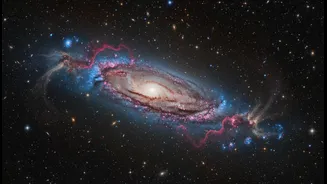
To mark the fourth anniversary of the James Webb Space Telescope's (JWST) scientific operations, NASA, the European Space Agency (ESA), and the Canadian Space Agency (CSA) have released stunning new images of a familiar celestial object: the galaxy Centaurus
A. Located a relatively close 11 million light-years from Earth, this galaxy has long been a subject of fascination and debate among astronomers. These new portraits, however, transform it into something far more complex and vivid than ever seen before, demonstrating the incredible power of Webb's instruments. Unlike older telescopes that were blocked by thick lanes of cosmic dust, JWST’s infrared capabilities pierce through the veil, revealing the galaxy's inner workings with astonishing clarity.
Galactic Archaeology in Action
Centaurus A is what is known as an active galaxy, meaning its core contains a supermassive black hole that is actively feeding on surrounding gas and dust, releasing enormous amounts of energy. It also bears the scars of a cataclysmic event—a collision with another galaxy that occurred roughly two billion years ago. This violent past makes it a perfect laboratory for studying how such mergers shape galactic evolution. Where previous images from telescopes like Hubble showed only obscured dust, Webb's vision resolves the galaxy's core into a dense tapestry of individual stars. What might look like simple graininess in the images is actually a densely packed field of millions of stars. Astronomers can now study these stars one by one, a practice they call "galactic archaeology," to reconstruct a timeline of the galaxy's history, from its first generation of stars to the bursts of star formation triggered by the ancient collision.
Unraveling Puzzling Structures
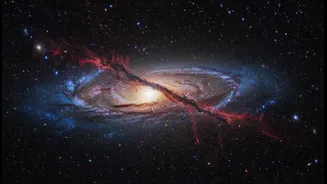
The new images highlight the galaxy's intricate dust structures in spectacular detail. Webb's Mid-Infrared Instrument (MIRI) reveals a warped, parallelogram-shaped band of glowing gas and dust cutting across the galaxy's center. Even more perplexing for astronomers is a faint, S-shaped feature traced in delicate ribbons of material. These unusual shapes pose new questions: What forces created them? How does the central black hole influence the surrounding dust? Are these the lingering effects of the long-ago merger? These are mysteries that scientists are now equipped to investigate, thanks to the unprecedented detail provided by Webb. The images are more than just beautiful cosmic portraits; they are rich datasets that will fuel scientific discovery for years to come.
A Universe of Constant Discovery
While the JWST revisits known objects with new eyes, other missions are charting entirely new territory. The ESA's Euclid telescope, another collaboration with NASA, is on a quest to map the "dark universe." In early July 2026, scientists announced that Euclid had discovered 31 new quasars from the dawn of time, including the most ancient one ever found. These incredibly bright objects, powered by supermassive black holes, act as cosmic lighthouses, allowing astronomers to probe the structure of the early universe and the distribution of dark matter. In another recent feat, Euclid captured the largest and most detailed visible-light photo ever of the Milky Way's core, revealing over 60 million stars and providing a treasure trove of data that will aid in the search for new exoplanets. These parallel efforts by different telescopes highlight a dynamic era of astronomy, where each new instrument and image builds upon the last to deepen our understanding of the cosmos.