






The New Baseline for Quality
Not long ago, a pixel-perfect website or a flawless presentation deck was a mark of distinction. Today, with AI tools capable of generating polished designs in seconds, that level of execution is simply the starting point. Creative directors now assume
a high level of finish. What they can't assume—and what they are desperately looking for—is the thinking behind the work. They aren't asking, "Did a machine help make this?" but rather, "Did a thoughtful designer guide it?" The fear of being 'caught' using AI is misplaced; the real risk is presenting work that shows no evidence of a strategic mind at the helm.
Show Your Process, Not Just the Product
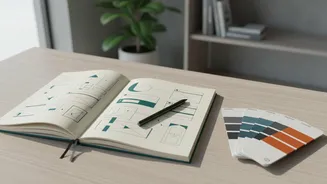
The most common and compelling advice from hiring managers is to pull back the curtain on your process. A beautiful final image demonstrates craft, but a case study that details your journey from problem to solution demonstrates value. This is where human designers have a distinct advantage. Your portfolio should include the 'messy middle': the initial research, the discarded sketches, the user flow diagrams, and the strategic pivots. Why did you choose this colour palette over another? What trade-offs did you make to balance user needs with technical constraints? Answering these questions proves you are a strategic partner, not just a pair of hands to execute a brief.
Talk About AI as a Tool, Not a Secret
Many designers worry that mentioning AI suggests they are taking shortcuts. However, progressive creative directors see AI proficiency as a valuable skill. The key is to frame it correctly. Don't hide your use of AI; document it as part of your workflow. Did you use an AI image generator to explore dozens of mood board concepts quickly? Did you use a language model to brainstorm campaign taglines or refine your case study text? Explaining how you use AI to be more efficient, explore more creative avenues, or synthesize research shows that you are a modern, adaptable professional who leverages the latest tools to achieve better results. Transparency is seen as a sign of confidence and honesty.
Connect Design to Business Outcomes
A visually stunning portfolio that doesn't speak to results is becoming less effective. In today's market, creative directors are under pressure to prove the business impact of their teams. Your portfolio is the perfect place to show you understand this. Wherever possible, quantify the results of your work. Did your app redesign lead to a 15% reduction in user drop-off? Did your packaging design contribute to a rise in sales? Even if you don't have hard numbers, you can articulate the strategic goals. Frame each project with the business problem you were trying to solve. This shifts the conversation from "I made a pretty thing" to "I created a solution that delivered value."
Champion Your Unique Taste and Point of View
Ultimately, AI is a great equalizer of technical skill, but it cannot replicate your unique taste, your personal history, or your specific point of view. Creative directors are looking for designers who have a distinct voice. Your personal projects, your speculative work, and the way you curate your portfolio are all opportunities to showcase this. Don't sand down your creative edges to fit what you think the market wants. In an environment saturated with algorithmically optimized content, a strong, original, and even quirky perspective is more valuable than ever. A portfolio that shows personality and conviction is one that a hiring manager will remember long after they've closed the tab.