

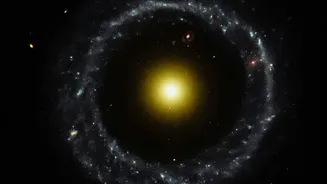
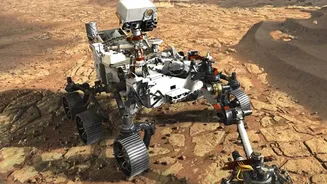
Webb: The Deep-Dive Specialist
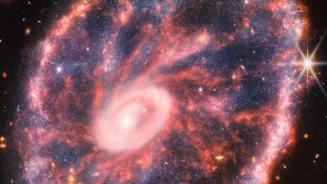
Since beginning operations, the James Webb Space Telescope has fundamentally changed our view of the universe. Its massive, gold-coated mirror and extreme sensitivity to infrared light allow it to peer back to the dawn of time, capturing light from the very
first stars and galaxies. Think of Webb as a cosmic detective with a powerful magnifying glass. It excels at focusing on a tiny patch of sky for long periods, uncovering faint and distant objects with unprecedented detail. This makes it the perfect tool for studying the atmospheric composition of a single exoplanet or dissecting the structure of an ancient galaxy. However, its incredible depth comes with a trade-off: a very narrow field of view.
Roman: The Grand Cosmic Surveyor
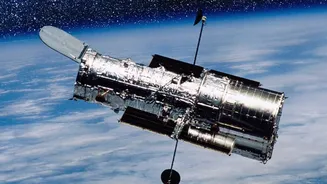
This is where the Nancy Grace Roman Space Telescope, slated for launch by early 2027, comes in. Named after NASA's first chief of astronomy, Roman is built for breadth and speed. Its primary mirror is the same size as Hubble's, but its key feature is an enormous field of view. In a single snapshot, Roman can capture an area of the sky 100 to 200 times larger than Webb or Hubble can, all while maintaining similarly sharp resolution. It will survey the sky up to 1,000 times faster than Hubble. If Webb is the detective with a magnifying glass, Roman is the team doing wide-scale surveillance, creating a massive, detailed map of the cosmic neighbourhood.
A Tale of Two Views
The difference in their viewing ability is staggering. To create its famous mosaic of the Andromeda Galaxy, Hubble required over 400 individual observations. Roman could capture the same area with just two. This wide-angle capability makes Roman a survey machine. Its mission is to systematically scan huge portions of the universe, creating unprecedented big-data maps of billions of galaxies and stars. This approach is designed to answer some of the biggest questions in cosmology by playing a numbers game—the more you can see, the more you can find.
Hunting for Dark Energy and New Worlds
Roman’s primary science objectives are to hunt for answers to two of the universe's greatest mysteries: dark energy and exoplanets. To investigate dark energy, the mysterious force causing the universe's expansion to accelerate, Roman will measure the positions and distances of millions of supernovae and galaxies. This massive survey will help astronomers map the evolution of the cosmos. For exoplanets, Roman will use a technique called gravitational microlensing to detect thousands of new worlds, including those much smaller or further from their star than other methods can find. This will create a vast catalogue of planets, providing a statistical census of how common different types of solar systems are.
A Powerful Scientific Partnership
The true power of these two telescopes lies in how they will work together from their shared orbital neighbourhood around the second Lagrange Point (L2). Roman will be the ultimate target finder. As it scans the sky, it will pinpoint countless objects of interest—rare galaxies, explosive supernovae, and intriguing exoplanets. It finds the cosmic needles in the universal haystack. Once Roman identifies these prime targets, Webb can swoop in for a closer look. With its powerful spectrometers and deep vision, Webb can perform detailed follow-up observations, analysing an exoplanet’s atmosphere for signs of water or studying a primordial galaxy in detail. This symbiotic relationship works both ways; Roman can also provide the wide-field context for a strange object Webb has already observed.