

The Sci-Fi Dream That's Now Fact
For decades, space travel has been defined by powerful chemical rockets that burn massive amounts of fuel for a short, powerful burst of energy. A solar sail is a completely different, more elegant concept. It's a spacecraft propelled not by an engine,
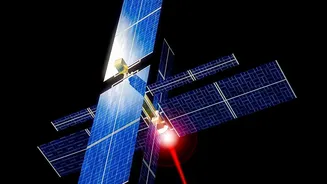
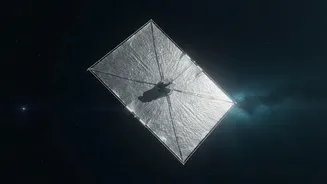
but by sunlight itself. Imagine a vast, reflective sheet, thinner than a human hair, unfurled in space. Instead of catching wind like a sailboat on the ocean, this sail catches the constant stream of light particles, or photons, flowing from the sun. This technology, once only a dream of visionaries like Carl Sagan, has been successfully demonstrated by missions like Japan's IKAROS and The Planetary Society's LightSail 2, proving that flight by light is possible.
Riding on Beams of Light
The physics behind solar sailing is both simple and profound. Light is made of particles called photons. While photons have no mass, they do carry momentum. When a photon from the sun strikes the highly reflective surface of a solar sail, it bounces off like a tiny ball hitting a mirror. In that moment, it transfers its momentum to the sail, giving it a tiny push. As countless photons continuously strike the sail's massive surface, these tiny pushes add up, creating a constant, gentle pressure known as solar radiation pressure. It's crucial to note this is different from the solar wind, which is a stream of charged particles and contributes less than one percent of the thrust. The force comes directly from the momentum of light itself.
The Incredible Power of a Gentle Nudge
The thrust generated by a solar sail is incredibly small. At Earth's distance from the sun, the force on a sail the size of a boxing ring is comparable to the weight of a feather in your hand. So how can this possibly propel a spacecraft? The answer lies in persistence. Unlike a rocket, which provides a massive push and then coasts, a solar sail is always accelerating. This gentle but continuous thrust builds up over time. In the frictionless vacuum of space, this constant acceleration allows a solar sail spacecraft to eventually reach enormous speeds, far greater than a conventional rocket with its finite fuel supply could ever achieve. Because it needs no propellant, a solar sail has what rocket scientists call an infinite specific impulse, a measure of fuel efficiency.
Engineering the Ultimate Sailboat
Creating a sail that can perform this feat is a significant engineering challenge. The material must be incredibly lightweight, extremely durable, and highly reflective. Most modern solar sails are made from materials like Mylar or Kapton, which is a polyimide film, coated with a microscopically thin layer of aluminum to make them shiny. The LightSail 2 mission, for instance, used a Mylar sail just 4.5 microns thick—about 1/5000th of an inch. These massive, delicate structures, sometimes covering an area of a boxing ring or even larger, must be compactly stowed for launch and then reliably unfurled in space, often using lightweight booms that extend like tape measures.
Navigating and Piloting the Craft
A solar sail doesn't just travel in a straight line away from the sun. Much like a sailboat on water, it can be steered. By changing the angle of the sail relative to the sun, operators can control the direction of the thrust. Tilting the sail changes the direction in which photons bounce off, allowing the spacecraft to be pushed forward, slowed down, or directed into a new orbit. This 'tacking' ability gives solar sails immense navigational flexibility without using any propellant, a feat demonstrated by the IKAROS mission, which used its sail to navigate on a flyby of Venus.
The Future of Long-Haul Missions
The advantages of solar sails become most apparent on long-haul missions. Free from the constraints of carrying fuel, these spacecraft are ideal for exploring the outer solar system and, one day, even travelling to other stars. A solar sail craft could reach the outer planets in months instead of years. The technology also opens up new possibilities for unique missions, such as a permanent solar storm warning station positioned between the Earth and sun, an orbit impossible to maintain with conventional propulsion. While challenges remain, especially in deploying ever-larger sails and developing more advanced materials, the path is clear. Solar sailing is no longer just a beautiful idea; it is a proven and practical technology that is set to become a workhorse of future space exploration.