




Step 1: Choose Your Night and Location
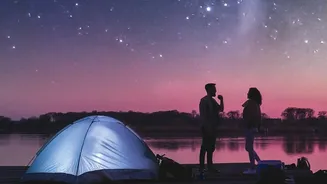
The success of your stargazing session hinges on two key factors: weather and darkness. First, check the forecast for a clear, cloudless night. Even thin, high-altitude clouds can obscure the faintest stars. Second, pay attention to the moon. For viewing
deep-sky objects like galaxies and nebulae, the best time is during the new moon phase, when the sky is at its darkest. If you can't wait for a new moon, plan your session for when the moon isn't in the sky; a first-quarter moon sets around midnight, leaving the early morning hours dark. Next, escape light pollution. City and suburban lights wash out the night sky, hiding all but the brightest stars. Use a light pollution map online to find a nearby park, rural area, or designated dark-sky site. Even driving 30 minutes away from city lights can make a dramatic difference. Look for a location with an open view of the horizon, away from direct streetlights or building lights.
Step 2: Gear Up (Without Breaking the Bank)
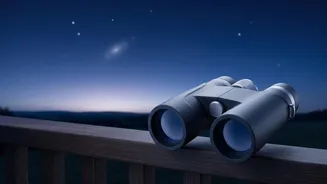
The beauty of binocular astronomy is its simplicity. Any pair of binoculars will show you more than your naked eye, but a standard 7x50 or 10x50 pair is ideal. The first number is the magnification (7x or 10x), and the second is the diameter of the lenses in millimeters; larger lenses gather more light, making faint objects brighter. Don't forget to dress for the occasion. Autumn nights can get chilly, so wear warm layers, a hat, and gloves. Bring a comfortable chair or a blanket to lie on, as you'll be looking up for extended periods. A red-light torch is essential; red light helps preserve your night vision, which can take up to 20 minutes to fully adapt to the dark. Finally, a stargazing app on your phone (in red-light mode) can be an invaluable guide to finding your way around the constellations.
Autumn Highlight 1: The Andromeda Galaxy (M31)
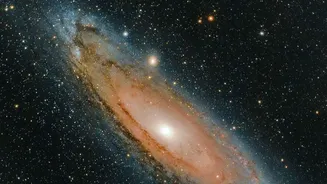
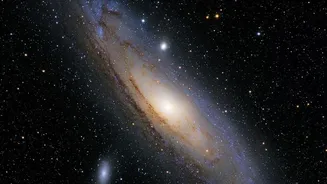
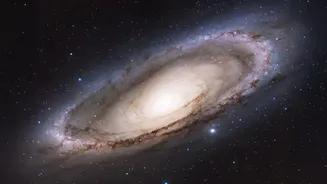
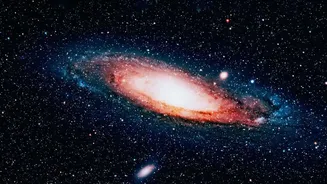
The star of the autumn sky is the Andromeda Galaxy, the most distant object you can see with the unaided eye. Located 2.5 million light-years away, it appears as a faint, fuzzy smudge to the naked eye under dark skies, but binoculars transform it into a glowing oval cloud. To find it, first locate the M-shaped constellation Cassiopeia in the northeastern sky. The right-hand 'V' of the 'M' acts as an arrow, pointing roughly in the direction of Andromeda. Scan that area slowly with your binoculars. With patience, you will spot its distinct, misty shape. In a good pair of binoculars, you can even begin to see that its central region is brighter and more concentrated. What you're seeing is a massive spiral galaxy containing a trillion stars.
Autumn Highlight 2: The Pleiades Star Cluster (M45)
Often mistaken for the Little Dipper, the Pleiades, or "Seven Sisters," is one of the most beautiful objects for any pair of binoculars. While you might see six or seven stars with your naked eye, binoculars reveal dozens sparkling in a tight group. Binoculars are arguably the best instrument for viewing this cluster, as most telescopes have too narrow a field of view to fit the entire object in at once. To find it, follow the line of Orion's belt upward to the bright, reddish star Aldebaran in the constellation Taurus. Continue that line, and you'll run right into the shimmering Pleiades. The stars have a distinct blue-white color, a sign of their young age. Through 10x50 binoculars on a dark night, you might be able to count 30 to 40 stars or more.
More Sights to Explore
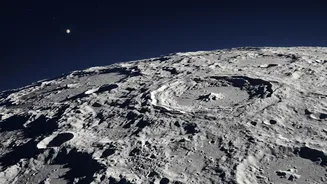
Once you've found the main attractions, there's plenty more to see. Your binoculars can split double stars like Algedi in Capricornus, where two stars appear close together but are actually separated by vast distances. Point them toward the Milky Way, which arches high overhead in early autumn, and just sweep slowly through the star-rich fields of Cygnus and Perseus. You'll stumble upon numerous open star clusters—small, dense gatherings of stars—that look like glittering patches against the dark. Another easy target is the Coathanger asterism, a chance alignment of stars that looks exactly like its name suggests. And don't forget the Moon itself. While a full moon washes out fainter objects, observing it with binoculars during its crescent or quarter phases reveals stunning detail in the craters and mountains along the terminator—the line between its light and dark sides.