





Our Crowded Skies
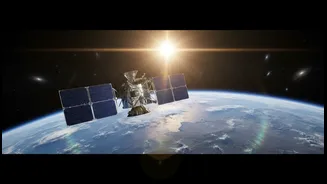
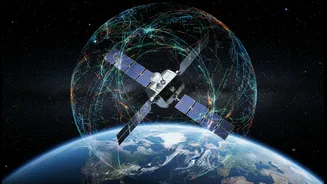
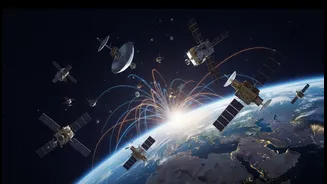
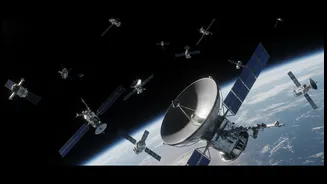
Low Earth Orbit (LEO), an orbital region up to 2,000 kilometres above our planet, is undergoing a historic transformation. Companies like SpaceX with its Starlink network and Amazon with Project Kuiper are deploying thousands of small satellites to provide
global internet coverage. The LEO satellite market is expanding rapidly, with projections showing it growing from over $7 billion in 2025 to more than $13 billion by 2030. This surge is driven by lower launch costs and the demand for high-speed, low-latency connectivity everywhere on Earth. However, this multi-billion dollar investment in orbital infrastructure is increasingly vulnerable to the unpredictable moods of our nearest star.
A Storm of Cosmic Proportions
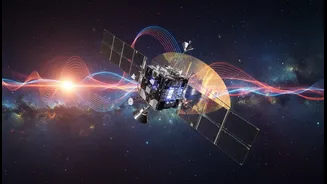
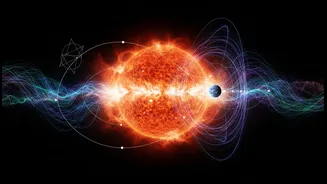
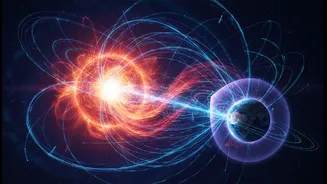
Space weather refers to the changing conditions in space driven by the Sun's activity. This includes solar flares, which are massive bursts of radiation, and coronal mass ejections (CMEs), which are giant clouds of charged particles hurled into space. When these phenomena are directed at Earth, they can cause geomagnetic storms by interacting with our planet's magnetic field. While these storms produce beautiful auroras, they also pose a significant threat to our technology-dependent society, capable of disrupting power grids, communications, and, most critically for this new orbital economy, satellites.
Satellites in the Firing Line
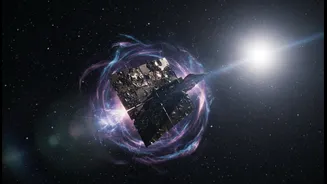
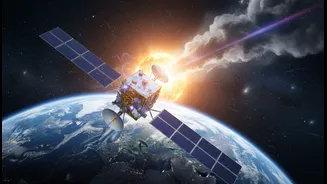
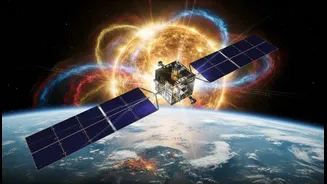
Satellites in LEO are particularly susceptible to space weather. During a geomagnetic storm, the energy dumped into Earth's upper atmosphere causes it to heat up and expand. This increases the atmospheric density at LEO altitudes, creating more drag on satellites. This drag slows the satellites down, causing their orbits to decay and potentially leading them to fall back to Earth prematurely if they cannot boost themselves back up. In a stark example from 2022, a moderate geomagnetic storm was blamed for the loss of up to 40 newly launched Starlink satellites. Beyond drag, energetic particles can damage sensitive electronics and solar panels, while atmospheric changes can interfere with communication and GPS signals.
The Rise of the Space Weather Forecaster
As the number of active satellites—and the economic value they represent—skyrockets, the need to predict these solar outbursts has become a critical business concern. Just as terrestrial businesses depend on weather forecasts, satellite operators now need reliable space weather predictions to protect their assets. This has fueled a growing industry of both public and private entities dedicated to monitoring the Sun and providing advance warnings. Government agencies like the US National Oceanic and Atmospheric Administration (NOAA) provide foundational forecasts, while a new wave of private companies is emerging to offer tailored, high-precision predictions for commercial clients. These companies use advanced AI models and data from solar observatories to give satellite operators the lead time they need to take protective measures, such as adjusting orbits or temporarily shutting down sensitive components.
A New Frontier for Careers
This emerging risk has created a new frontier of job opportunities. The field needs more than just traditional atmospheric and space scientists. There is a growing demand for data scientists and software developers to build and refine the complex AI models that predict solar activity. Satellite operators and aerospace companies are hiring space systems engineers with expertise in space weather effects to design more resilient spacecraft and manage constellation flight operations. There are roles for space weather analysts who work in 24/7 operational centres, much like their terrestrial counterparts, issuing warnings and advisories. The career possibilities extend to roles in policy, risk management, and insurance, as the entire space economy grapples with the financial implications of solar storms. As our reliance on space becomes more deeply embedded in our daily lives, the people who can safeguard that infrastructure will be in ever-greater demand.