


The Student-Led Mission
While NASA and international space agencies tackle this problem, so are the next generation of scientists. In Texas, a team of students—Varshini Gandreddy, Dhiti Koyya, and Raaga Bukkaraju—developed a concept called 'Gaia's Outpost' for the Conrad Challenge,
an innovation competition. Their project addresses the core issue head-on: how to turn the toxic, lifeless Martian surface into fertile ground. Their proposal aims to process the hazardous local material, known as regolith, into a medium that can support agriculture. This kind of student-driven ingenuity is crucial, as it explores practical solutions for a problem that was once pure science fiction. They even earned an award at the 2026 Conrad Challenge Innovation Summit at Space Centre Houston for their thoughtful presentation of the concept. Their work highlights a growing movement to solve the puzzle of off-world survival, starting from the ground up.
The Trouble with Martian 'Soil'
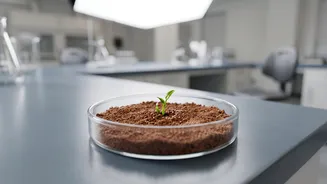
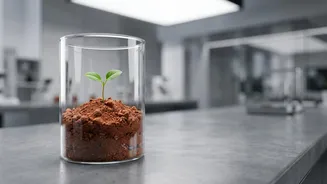
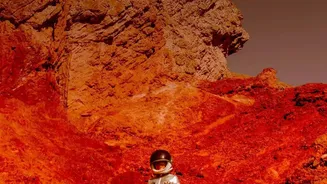
The primary obstacle for any aspiring Martian gardener is the so-called soil itself. It isn't soil in the earthly sense at all. Mars is covered in regolith, a mix of fine dust and crushed rock that contains no organic matter or the beneficial microbes essential for plant life. Worse, Martian regolith is laced with perchlorates, a class of toxic salts. At concentrations found on Mars, these compounds are harmful to both humans and plants, inhibiting growth and potentially making any resulting crops unsafe to eat. Experiments have shown that while some plants can germinate in regolith simulants, the presence of perchlorates often prevents growth entirely. Getting around this requires significant processing. The simplest proposed solution involves 'washing' the regolith with water to rinse away the toxic salts, a critical first step before any seeds can be planted.
More Than Just Bad Dirt
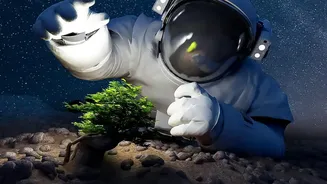
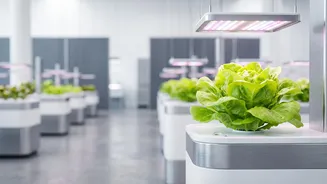
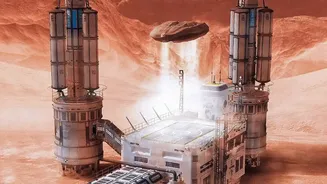
Even if the soil toxicity is solved, numerous other environmental hurdles remain. Mars receives less than half the sunlight of Earth, and frequent dust storms can further obscure the sky for long periods. This means any Martian farm would likely need to be housed in a greenhouse, supplemented with powerful artificial lighting like LEDs. Then there's the issue of water. While we know water ice exists on Mars, it's not readily available and is often very salty, requiring purification before it can be used for crops. The thin Martian atmosphere and extreme cold—dropping to temperatures as low as -153°C—mean any agricultural habitat would need to be pressurized and heated, demanding a tremendous amount of energy. Furthermore, the lack of a substantial atmosphere means plants and farmers would be exposed to dangerous levels of cosmic radiation, necessitating underground habitats or heavy shielding.
From Earth Labs to Martian Greenhouses
Despite the challenges, progress is being made. Researchers in the Netherlands have successfully grown crops like tomatoes, wheat, and cress in Mars soil simulants (without perchlorates). Their results showed that Martian regolith simulant could even outperform nutrient-poor Earth soil in some cases, demonstrating its potential once key problems are solved. NASA has been conducting its own experiments for years, with astronauts on the International Space Station (ISS) successfully growing lettuce, chili peppers, and tomatoes in microgravity. These experiments, using systems like 'Veggie' and the upcoming 'Ohalo III', are less about the soil and more about mastering controlled environment agriculture—perfecting lighting, water delivery, and nutrient solutions in so-called hydroponic and aeroponic systems. The lessons learned aboard the ISS are invaluable for designing the closed-loop life support systems that a Martian colony would depend on.