



The Invisible Threat of Deep Space
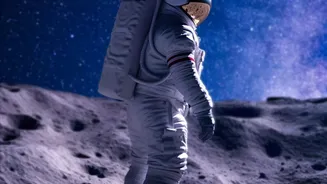
The Moon has no atmosphere or global magnetic field to protect it, leaving its surface exposed to a relentless barrage of space radiation. This comes from two main sources: a constant stream of galactic cosmic rays (GCR) from distant exploding stars and
periodic, intense bursts of solar energetic particles from our own Sun. For future astronauts planning to stay on the Moon for weeks or months, this radiation poses a severe health risk, greatly increasing the chances of cancer and other long-term illnesses. Measured levels on the lunar surface are hundreds of times higher than on Earth. Simply put, any long-term human presence requires a robust shielding solution far more effective than what a standard surface habitat or spacesuit can provide.
Nature's Underground Shelters
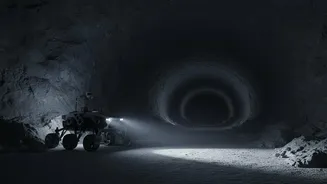
The most promising solution may have been waiting for us all along. Billions of years ago, when the Moon was volcanically active, rivers of lava carved out immense underground tunnels. As the lava drained away, it left behind hollow caverns known as lava tubes. Orbiters have identified numerous pits on the lunar surface, believed to be 'skylights' where the roof of a lava tube has collapsed. These tubes are enormous, with some potentially large enough to house entire cities. More importantly, the thick ceiling of solid rock—estimated to be tens of meters thick in places—provides a near-perfect shield. This natural barrier would protect a habitat not only from radiation but also from micrometeorite impacts and the Moon's extreme temperature swings, which can vary by hundreds of degrees between day and night.
Meet the Robotic Cave Explorers
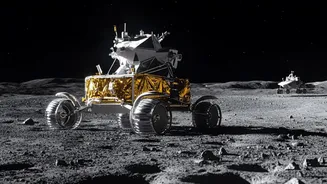
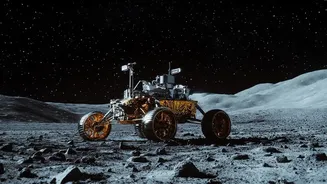
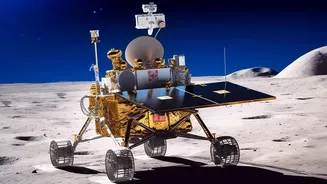
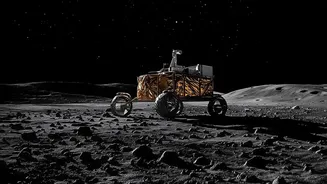
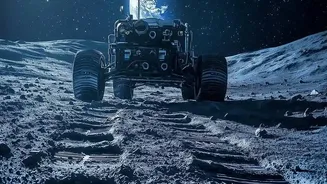
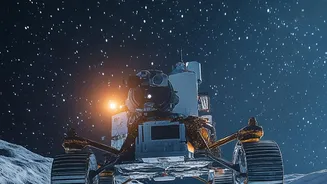
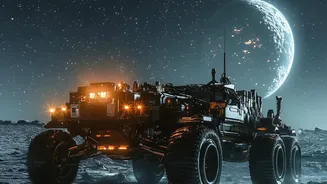
Before we can set up a base, we need to know what’s down there. The interiors of these tubes are completely dark, the terrain is unknown, and the entrances can be sheer vertical pits. This is a job for specialized robots. Space agencies and private companies are developing a new generation of subterranean rovers designed for this very task. Some concepts involve teams of robots working together, where one might stay at the entrance to act as a communication relay for another that ventures deeper into the cave. Other designs, like the recently funded Lunar Underground eXplorer (LUX), propose a hovering drone that rappels into a pit while tethered to a surface rover by a fiber-optic cable that provides power and streams data. These machines are being designed for extreme autonomy, able to navigate treacherous, unmapped environments far from human control.
Charting the Subterranean Frontier
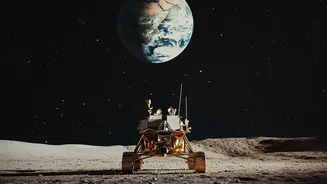
The first step in utilizing these caves is reconnaissance. Missions are being designed to first survey potential sites from the surface. A rover could use gravimetric sensors to measure subtle changes in gravity, which would indicate a large void or tunnel beneath the ground, helping to confirm a lava tube's existence and extent before attempting entry. Once a promising tube is found, the next challenge is getting inside and mapping it. A robot would need to create a detailed 3D map of the cave's interior, assess its structural stability, and identify flat, safe areas suitable for constructing a habitat. Communication is another hurdle; without a direct line of sight to the surface, rovers will need innovative solutions like deploying a chain of communication nodes or using a physical tether to send information back. These early reconnaissance missions are critical for turning a promising idea into a viable plan.