






The Endless Cat-and-Mouse Game
The core challenge in identifying AI-generated content is the relentless pace of innovation. For every new detection method, a more advanced image generator is created to overcome it. AI image detectors are typically machine learning models trained to spot
the statistical ghosts left behind by generation processes—things like unnatural textures, pixel patterns, or consistent digital 'noise'. However, as generative models evolve, these tell-tale signs change or disappear entirely, making detectors trained on older models quickly obsolete. Recent research shows that while detectors perform well in controlled lab settings, their accuracy plummets when faced with images 'in the wild' that have been compressed, cropped, or edited—common occurrences on any social media platform. This creates a never-ending arms race where perfect, automated detection remains perpetually out of reach.
Why Certainty Is an Impossible Goal
The idea of a tool that can declare an image 'real' or 'AI-generated' with 100% accuracy is appealing, but it's a dangerous fantasy. In practice, these detectors are probabilistic, meaning they provide a confidence score, not a definitive verdict. They are essentially making an educated guess based on statistical comparison. This leads to significant problems with both false positives (flagging a real photo as AI) and false negatives (missing a synthetic one). A real photograph that has been heavily edited, had its noise reduced by an AI tool, or was taken with a telephoto lens that creates a smooth background can be misidentified as AI-generated because its characteristics mimic synthetic content. Demanding absolute certainty from these tools is not only unrealistic but also risky, as incorrect labels can harm creators and erode trust just as much as undetected fakes.
A Smarter Approach: Probabilistic Labeling
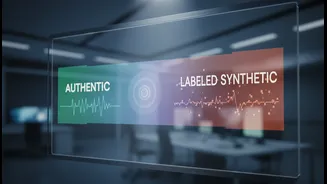
Instead of a binary 'real' or 'fake' label, a more honest and effective approach is to communicate uncertainty to the user. This is where probabilistic labeling comes in. Imagine a label that, instead of stating an image is AI-generated, says something like, "This image has features commonly associated with AI generation." This shifts the goal from making an impossible judgment to providing transparent context. Platforms like Meta are already moving in this direction, applying 'AI info' labels to a wider range of content rather than simply removing it. This approach treats the user as an intelligent partner, giving them information to foster critical thinking rather than making an authoritative (and potentially wrong) declaration on their behalf. The focus becomes empowering the user, not infantilizing them with a simple, often misleading, verdict.
Enter Content Credentials: A Digital 'Nutrition Label'
A parallel solution gaining significant traction is the C2PA (Coalition for Content Provenance and Authenticity) standard, often presented to users as 'Content Credentials'. Think of it as a digital nutrition label for media. Instead of trying to guess an image's origin from its pixels, C2PA allows creators and tools to attach tamper-evident metadata to a file from the moment of its creation. Major AI generators from companies like OpenAI, Adobe, and Google are already embedding C2PA manifests that clearly state an image was AI-generated and by which tool. This doesn't stop bad actors from stripping the metadata, but it creates a powerful way to verify authentic content from trusted sources. When you see an image with a verifiable Content Credential, you can trace its history, including what tools were used to create and edit it, providing a layer of trust that post-hoc detection can't match.
The Future Is Human-Centric
Ultimately, technology alone cannot solve the problem of synthetic media. Neither probabilistic labels nor provenance systems are silver bullets. Research shows that while labels can influence a user's belief about whether content is AI-generated, they don't necessarily change engagement behaviours like sharing or liking. The most effective path forward is a combination of approaches. This includes smarter, more transparent labeling that educates users about probabilities, wider adoption of provenance standards like C2PA, and a renewed emphasis on media literacy. The goal is not to eliminate AI-generated content, but to build a digital ecosystem where users are equipped with the context and critical thinking skills needed to navigate a complex information environment. The future of trust online depends less on a perfect machine and more on an empowered human.