

A New Clue in a Distant World
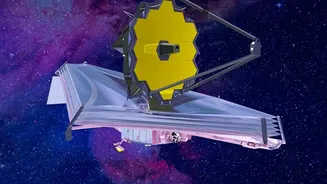
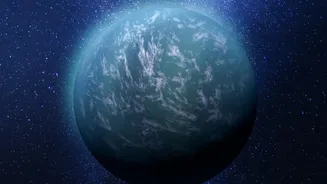
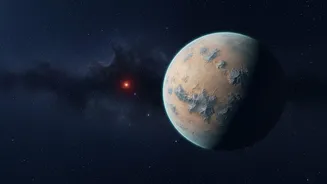
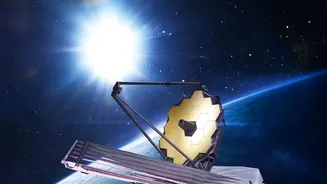
More than 120 light-years away, in the constellation Leo, lies an exoplanet named K2-18 b. This world, 8.6 times the mass of Earth, has become a focal point for astronomers. Using its powerful instruments, the James Webb Space Telescope (JWST) peered
into the planet's atmosphere and made a landmark discovery: the clear presence of carbon-bearing molecules, specifically methane and carbon dioxide. This finding is significant because K2-18 b orbits within its star's 'habitable zone'—the region where conditions could be right for liquid water to exist. The presence of these gases supports the theory that K2-18 b could be a 'Hycean' world: a planet with a hydrogen-rich atmosphere covering a vast water ocean. While these are not the first gases detected on an exoplanet, finding them on a potentially ocean-covered world in the habitable zone is a major step forward.
The Cosmic Significance of Carbon
On Earth, all life is carbon-based. From the smallest microbe to the largest whale, carbon forms the backbone of the essential molecules of life, including DNA and proteins. For this reason, astrobiologists consider carbon a crucial 'biosignature'—a substance that provides evidence of past or present life. Finding carbon dioxide and methane in the atmosphere of K2-18 b is therefore incredibly exciting. It confirms that the basic chemical building blocks for life as we know it exist on a world far beyond our solar system. However, it's not proof of life. These gases can also be produced by geological or chemical processes that have nothing to do with biology. What makes the discovery so compelling is the combination of gases and the planet's environment. The specific abundance of methane and carbon dioxide, along with a lack of ammonia, strongly supports the hypothesis of a water ocean, making it a prime target for further investigation.
How Webb Peeks into Alien Skies
Characterising the atmospheres of planets hundreds of light-years away is an incredible technical feat. These planets are incredibly faint and are lost in the glare of their parent stars. The JWST uses a technique called transit spectroscopy. As K2-18 b passes in front of its star from our perspective, a tiny fraction of the starlight filters through the planet's atmosphere. Different gas molecules absorb specific wavelengths, or colours, of light. By capturing the starlight that has passed through the atmosphere, JWST's spectrographs can spread that light into a rainbow-like spectrum. The missing slivers of light in this spectrum act as a chemical fingerprint, revealing precisely which gases are present. Webb's unprecedented sensitivity and its focus on infrared light are what make these detailed observations possible, revealing a level of atmospheric detail that was previously out of reach.
From Promising Clue to Verified Proof
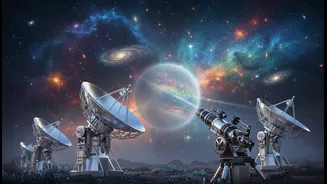
The detection of carbon is a beginning, not an end. The data from K2-18 b also contained a tantalising, though unconfirmed, hint of another molecule: dimethyl sulfide (DMS). On Earth, DMS is overwhelmingly produced by life, particularly marine phytoplankton. This potential detection caused a surge of excitement, but scientists are urging caution. The DMS signal is weak and requires much more data to be confirmed. Subsequent studies have also suggested that non-biological processes might be able to produce DMS in a hydrogen-rich atmosphere like K2-18 b's. The scientific process now involves pointing Webb at the planet again for longer observations to verify the DMS signal and search for other biosignatures. At the same time, other teams are conducting different kinds of searches, including using powerful radio telescopes to listen for any potential 'technosignatures'—signs of technology—though none have been found so far.