


The Challenge of Distant Weather
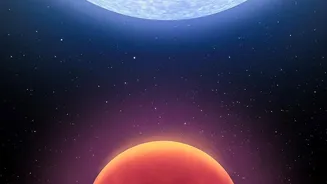
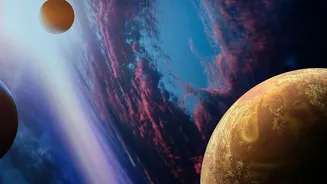
Measuring weather on a planet light-years away presents an immense challenge. These worlds, known as exoplanets, are too distant to see in detail, appearing as just a faint speck of light next to their brilliant host stars, if they can be seen at all.
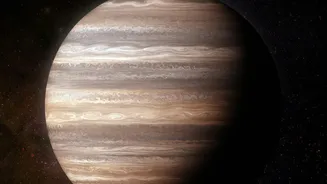
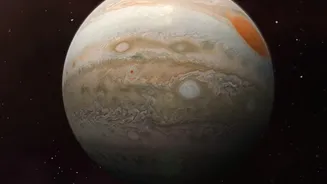
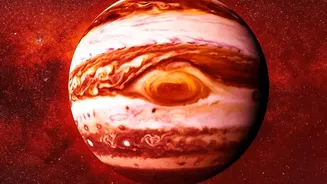
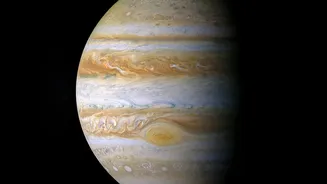
Directly observing clouds to track their movement, a method used for planets like Jupiter in our solar system, is impossible. Instead, scientists need a way to analyse the planet’s atmosphere remotely, using only the light that reaches our telescopes.
Harnessing the Power of Infrared
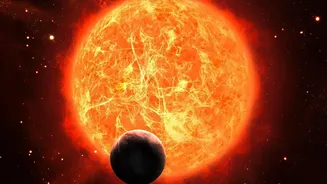
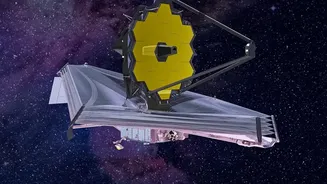
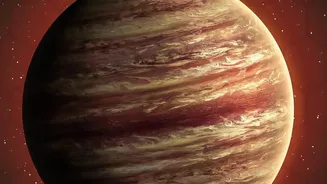
The key is to look not in visible light, but in the infrared spectrum. Powerful observatories like the James Webb Space Telescope (JWST) are designed specifically for this. Infrared light is essentially heat radiation. By observing an exoplanet in infrared, scientists can detect the faint glow emitted by the planet itself. This allows them to create temperature maps and study worlds that would otherwise be lost in the glare of their star. This is especially effective for a class of exoplanets called 'hot Jupiters'—gas giants orbiting extremely close to their stars, with scorching surface temperatures.
Reading Atmospheric Fingerprints
To understand what's happening in that atmosphere, scientists use a technique called high-resolution spectroscopy. As light from the host star passes through the planet’s atmosphere, or as the planet’s own heat radiates into space, the chemicals in the atmosphere absorb and emit light at very specific infrared wavelengths. This creates a unique 'fingerprint' or spectrum. Each element, like iron or calcium, has a known spectral signature, allowing astronomers to determine the chemical composition of the air on a world they will never visit.
Chasing the Doppler Shift
This is where the wind measurement comes in. The technique relies on the Doppler effect, the same principle that makes an ambulance siren sound higher-pitched as it approaches and lower as it moves away. As gases in an exoplanet's atmosphere move, either toward or away from us, their spectral fingerprints are shifted slightly. If a massive wind is blowing from the planet's hot, star-facing dayside to its cooler nightside, the chemical signatures from the part of the atmosphere moving toward Earth will be shifted to the blue end of the spectrum. The part moving away will be shifted to the red end. This is known as a Doppler shift.
From Shift to Supersonic Speed
By precisely measuring the extent of this Doppler shift, astronomers can calculate the speed of the atmospheric gases. The greater the shift, the faster the wind. Using high-resolution spectrographs on telescopes like the Very Large Telescope and at the Keck Observatory, scientists have clocked winds on hot Jupiters moving at incredible velocities. On a world named HAT-P-70 b, winds were measured at up to 18,000 kilometres per hour. On another, KELT-9 b, evidence points to day-to-night winds screaming at up to 11.7 km/s, or over 42,000 km/h. These speeds are far beyond supersonic and represent some of the most extreme weather conditions ever recorded.
Why These Wild Winds Matter
Studying these extreme winds is more than just cosmic weather reporting. It helps scientists understand how planets distribute heat from their star-facing side to their dark side, a crucial factor in any planet's climate. On some planets, scientists have found that winds are slower than expected at higher temperatures, which could be the first indirect evidence of magnetic fields acting as a brake on the atmosphere. Understanding these fundamental dynamics is a key step in figuring out which distant worlds might have stable enough environments to retain their atmospheres and water, and perhaps, one day, support life.