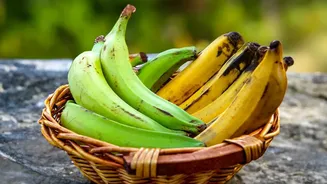

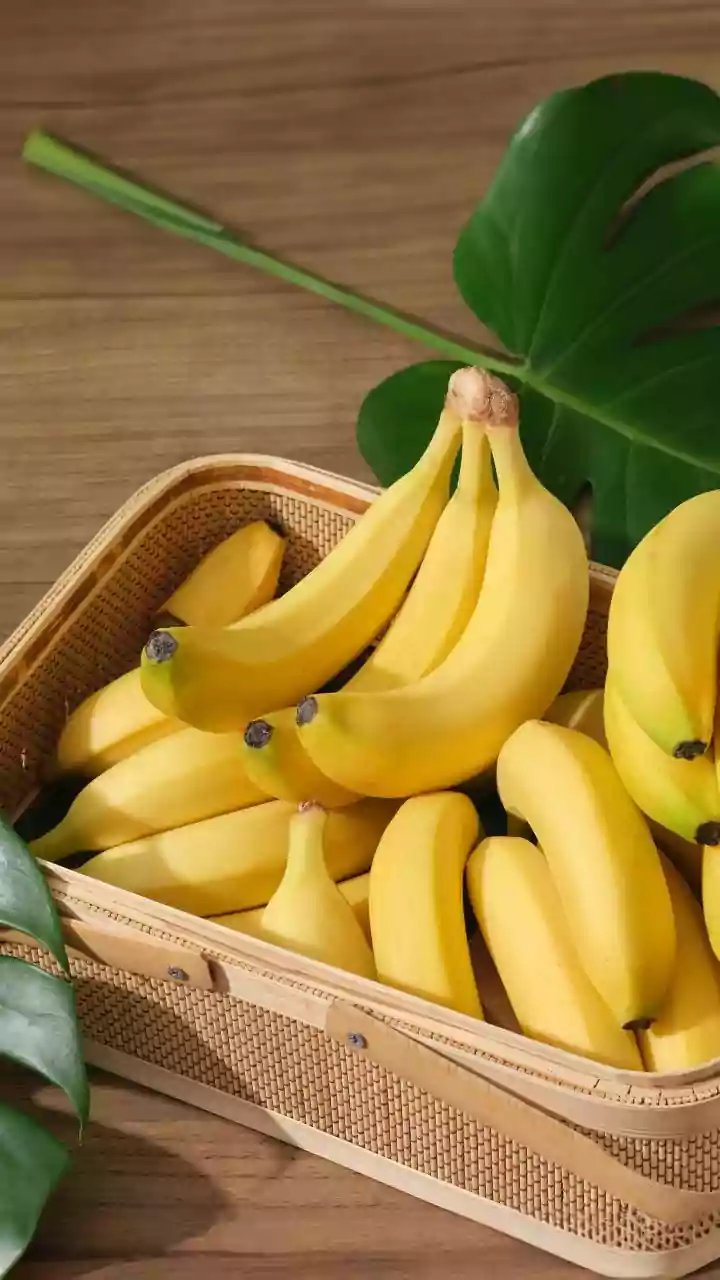
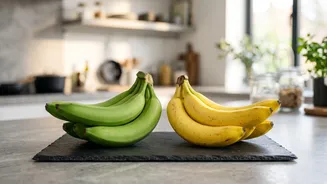
It's a staple in every fruit bowl, but the banana you eat is a different fruit depending on its colour. From green to yellow, the ripeness level dramatically changes its nutritional makeup, particularly its starch and sugar content.
The Great Starch Transformation
The fundamental difference
between a green, unripe banana and a soft, yellow one lies in its carbohydrate composition. A green banana is packed with starch, specifically resistant starch. Up to 80% of the dry weight of a green banana is starch. This type of starch 'resists' digestion in your small intestine, acting more like a dietary fibre. As the banana ripens, a natural hormonal process kicks in, and enzymes begin breaking down this complex resistant starch into simple sugars like sucrose, glucose, and fructose. By the time a banana is fully ripe and yellow, its starch content plummets to as low as 1%, while its sugar content can climb to over 16% of its weight. This is why green bananas have a firm, sometimes waxy texture and a less sweet, almost bitter taste, while ripe bananas are soft and sugary.
Blood Sugar and the Glycemic Index
Because of the dramatic shift from starch to sugar, the effect of a banana on your blood sugar depends heavily on its ripeness. Foods are ranked on a glycemic index (GI) scale based on how quickly they raise blood glucose levels. Thanks to their high resistant starch content, green bananas have a low GI, typically around 30 to 42. This means they release energy slowly and cause a more gradual rise in blood sugar, making them a better choice for individuals managing blood sugar levels, such as those with type 2 diabetes. As the starch converts to sugar, the GI of a ripe, yellow banana increases to a moderate level, generally between 51 and 62. This provides a quicker source of energy, which can be ideal for athletes or anyone needing a fast boost before a workout.
A Friend to Your Gut Microbiome
The resistant starch in green bananas isn't just for show; it serves a crucial function as a prebiotic. Since it passes through the small intestine undigested, it reaches the large intestine, where it becomes food for your beneficial gut bacteria. This fermentation process produces short-chain fatty acids (SCFAs), like butyrate, which is the primary fuel for the cells lining your colon and supports a healthy gut barrier. Along with resistant starch, green bananas are also a good source of pectin, another type of fibre that helps maintain the fruit's structure. Pectin decreases as the banana ripens, contributing to the soft, mushy texture of an overripe fruit. Both resistant starch and pectin can help you feel fuller for longer, potentially aiding in weight management.
Micronutrients and Antioxidants
While the carbohydrate profile changes dramatically, both green and yellow bananas are great sources of key nutrients like potassium, vitamin B6, and vitamin C. These micronutrient levels remain relatively stable throughout the ripening process. However, the antioxidant content does change. As a banana ripens and the green chlorophyll in the peel breaks down, the levels of certain antioxidants, particularly those linked to cell protection like catechins, actually increase. While green bananas are nutritional powerhouses for gut health, fully ripe bananas deliver a stronger punch of these free radical fighting compounds. Some research also indicates that the nutrients in ripe bananas may be more easily absorbed by the body.
Green or Yellow : Which Is for You?
So , which banana should you choose ? The answer depends entirely on your personal health goals and preferences . If you 're focused on managing blood sugar , improving gut health with prebiotics , and promoting a feeling of fullness , then a less - sweet , firmer green banana is your best bet . They can be eaten raw , though their starchy taste might not be for everyone . They are also popularly cooked in savoury dishes , which is common in many cuisines . Conversely , if you need a quick and easily digestible energy source , a sweeter and softer ripe banana is the ideal choice . Their higher sugar content makes them perfect for pre - workout fuel or for adding natural sweetness to smoothies and baking , like the classic banana bread . Some people may also find ripe bananas easier to digest , while others might experience gas or bloating from the high resistant starch in green ones .