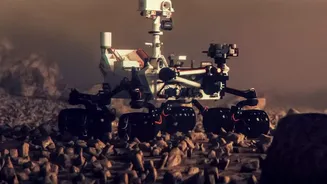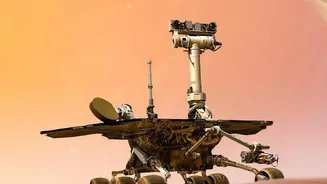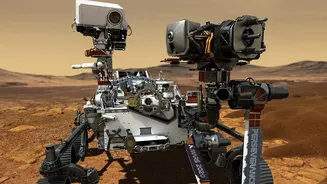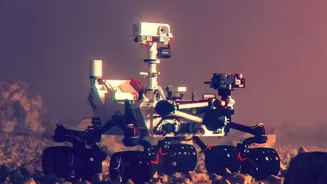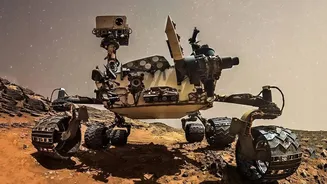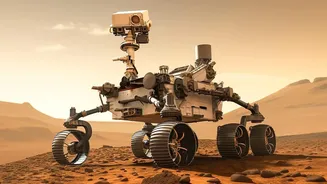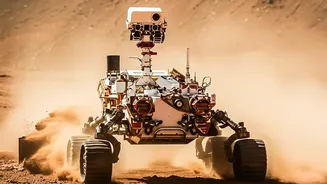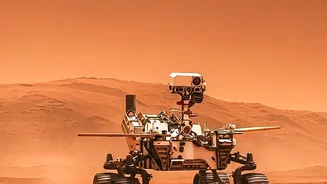





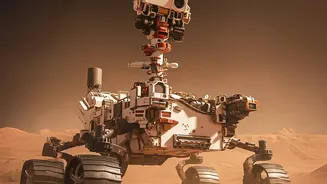
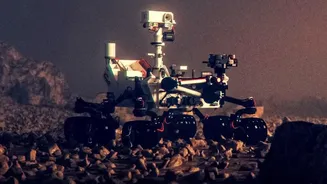
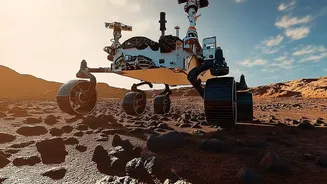
Bringing pieces of Mars back to Earth is one of humanity's greatest scientific quests. NASA's Perseverance rover is already on the job, collecting samples. Now, the agency has a new plan for the next crucial step: getting them home.
The Ultimate Souvenir Hunt
For years, the Mars
Sample Return (MSR) mission has been a top priority for NASA and its partner, the European Space Agency (ESA). The goal is audacious: retrieve the rock, soil, and atmospheric samples currently being collected by the Perseverance rover and bring them to Earth for study in advanced labs. Since its landing in February 2021, Perseverance has been exploring Jezero Crater, a location believed to have once been a river delta, drilling and sealing compelling specimens into titanium tubes. These samples could hold the key to answering one of our most profound questions: was there ever life on Mars?
A Mission in Need of a Reboot
The original plan for retrieving these precious samples was incredibly complex. It involved sending a dedicated lander to Mars carrying a separate 'fetch rover' to collect the tubes left by Perseverance. This fetch rover would then deliver the samples to a Mars Ascent Vehicle (MAV), a small rocket that would launch them into Martian orbit. However, independent reviews projected the cost of this multi-part mission to be enormous—potentially up to $11 billion—with a timeline stretching into the 2040s, a delay NASA Administrator Bill Nelson deemed 'unacceptable'. This sticker shock and complexity sent the agency back to the drawing board.
Enter the PSRA Initiative
On November 9, 2026, NASA officially announced a new approach: the Perseverance Sample Retrieval Architecture, or PSRA. This isn't a finalized mission plan just yet, but rather a new initiative to develop a more streamlined and efficient strategy. Announced by Tiffany Morgan, director of NASA's Mars Exploration Program, the PSRA aims to assess all options for getting the samples back. A dedicated strategy team will kick off its work in January 2027 with the goal of delivering impartial recommendations by the winter of 2027-2028. The core idea is to learn from past reviews and evaluate current capabilities to create a faster, simpler, and less expensive mission.
What Might the New Plan Look Like?
While the PSRA team will explore multiple options, earlier discussions about simplifying the mission provide strong clues. A leading concept involves scrapping the separate fetch rover entirely. Instead, the robust and still-healthy Perseverance rover would take on the additional duty of delivering the samples directly to the Sample Retrieval Lander itself. This would reduce the number of new, complex components needed for the mission. The lander would still carry the crucial MAV to launch the samples into orbit. As a backup, the original plan included two small helicopters, similar to the successful Ingenuity helicopter, to retrieve any samples Perseverance couldn't deliver, a feature that might be retained in a new architecture.
A New Space Race?
There's an added sense of urgency fueling this strategic rethink. China is moving forward with its own ambitious Mars sample return mission, Tianwen-3. Current plans show China aiming to launch its mission around 2028 and return samples to Earth as early as 2031. This has been described as a potential 'Sputnik moment', adding a competitive element to the scientific goals. By re-evaluating its own approach, NASA is not only addressing budget and complexity concerns but also positioning itself to remain at the forefront of planetary exploration. The PSRA's findings will be critical in determining America's path forward in the quest to unlock the secrets of the Red Planet.