



Answering the 'Why' of AI
For decades, space exploration has been a human-led endeavor, with every command and analysis originating from mission control on Earth. But as our probes venture farther and our telescopes peer deeper, this model faces two fundamental challenges: time
and scale. Communication delays to Mars can be up to 20 minutes each way, making real-time human control impossible. Meanwhile, observatories generate more data in a day than scientists could sift through in a lifetime. Just this week, NASA announced its participation in the Genesis Mission, a federal initiative to apply AI to massive datasets, including over 150 petabytes of the agency's archival and real-time mission data. This move signals a strategic shift. AI is no longer a niche tool but a core component for making missions more autonomous, efficient, and capable of discoveries that would otherwise remain hidden.
The Autonomous Explorer
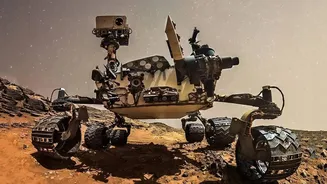
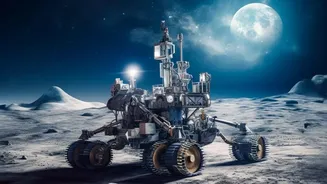
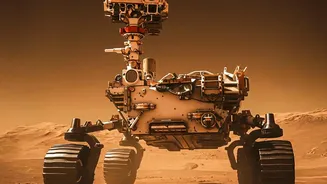
Nowhere is this partnership more visible than on the surface of other worlds. On Mars, the Perseverance rover uses AI to navigate treacherous terrain on its own. Its autonomous navigation system, known as AutoNav, enables it to analyze images of the ground ahead, identify hazards like large rocks or steep slopes, and plot a safe path without waiting for instructions from Earth. In fact, a remarkable 88% of the rover's driving has been done autonomously, allowing it to cover ground on terrain never before seen by human eyes. This capability is crucial for exploration, turning the rover from a remotely operated vehicle into a semi-independent robotic field geologist. NASA is also developing new radiation-hardened computer chips specifically designed to handle the intense processing demands of AI in deep space, promising performance hundreds of times greater than current spaceflight computers.
A Team of Robotic Scouts
The next evolution in AI-driven exploration involves not just one smart robot, but a team of them. This is the goal of NASA’s Cooperative Autonomous Distributed Robotic Exploration (CADRE) mission, set to land on the Moon in 2026. This technology demonstration will deploy three suitcase-sized rovers that will work together as an autonomous team. Without minute-by-minute commands from humans, the rovers will elect their own leader, coordinate their movements, and collectively map the lunar surface in 3D using ground-penetrating radar. By working in formation, they can perform synchronized measurements that a single rover could never accomplish, providing a richer, multi-dimensional view of the lunar subsurface. The success of CADRE could pave the way for future missions where swarms of robots could explore hazardous or complex environments on their own.
Unlocking Cosmic Secrets in Data
Beyond navigating rovers, AI is becoming an indispensable tool for scientific discovery. NASA’s telescopes collect an immense volume of information, and AI algorithms are uniquely suited to find the proverbial needle in the cosmic haystack. Machine learning systems, for example, have been trained to sift through data from the Kepler Space Telescope to identify exoplanets that human analysts might miss; one such system, called ExoMiner, recently validated over 300 new planets. Similarly, AI is used to analyze light patterns to predict cosmic events, help scientists understand space weather, and even support disaster relief efforts on Earth by rapidly analyzing satellite imagery. The goal of the new Genesis Mission is to accelerate these breakthroughs, reducing analysis timelines from years to mere days and unlocking new insights from decades of archived mission data.