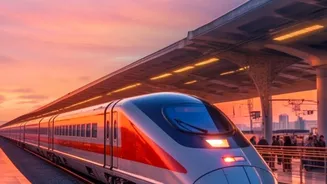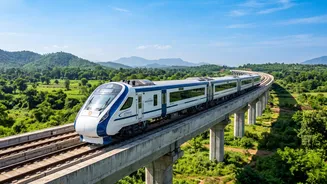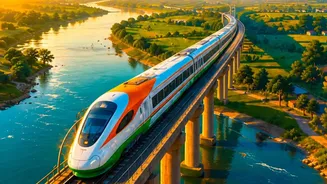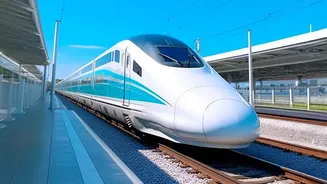






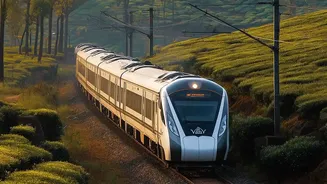
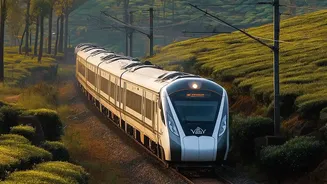
India's dream of high-speed rail is rapidly taking shape. The ambitious Mumbai-Ahmedabad bullet train project has a firm target: the first section connecting Surat and Vapi is scheduled to open for passengers in the last quarter of 2027.
The First Leg of a Landmark Journey
The initial focus
is on making the Gujarat portion of the corridor operational first. The approximately 100-kilometre stretch between Surat and Vapi has been chosen as the inaugural section for India's first bullet train service. According to Railway Minister Ashwini Vaishnaw, this phased approach of opening ready sections will allow the public to experience high-speed rail sooner. This section is part of the larger 508-kilometre Mumbai-Ahmedabad High-Speed Rail (MAHSR) corridor. Significant progress has been made here, with a recent milestone being the energisation of the overhead electrical equipment on the 50-kilometre Surat-Bilimora portion, a critical step towards trial runs.
An Engineering Marvel Taking Shape
The scale of construction is immense. As of late 2026, hundreds of kilometres of the elevated viaduct, which forms the backbone of the line, are already complete. Civil works for eight stations in Gujarat are finished, with architectural finishing now in progress. The project incorporates advanced Japanese Shinkansen technology, designed for an operating speed of 320 kmph. This will drastically cut travel time, with the full Mumbai-Ahmedabad journey expected to take just under two hours, compared to the current eight to nine hours by road. The infrastructure includes not only elevated tracks but also mountain tunnels and India's first undersea rail tunnel beneath Thane Creek, showcasing the project's engineering complexity.
Overcoming Hurdles and Pushing Forward
The journey to this point has not been without challenges. The project, officially launched in 2017, faced significant delays, particularly in Maharashtra, due to issues with land acquisition and state permissions. Railway Minister Ashwini Vaishnaw has noted that serious construction has effectively been underway for about five years, after these initial hurdles and the impact of the COVID-19 pandemic were overcome. With most of the land acquisition issues now resolved, especially in Gujarat, construction has gained significant momentum. This renewed pace has made the 2027 target for the first section a tangible goal.
The Road to 2027 and Beyond
Before passengers can board, a series of crucial tests must be completed. Trial runs on the Surat-Bilimora section are expected to begin around May 2027. These trials will use the new indigenous B28 trainset, designed for speeds up to 280 kmph and manufactured in India by ICF and BEML. This train has already passed a critical 'squeeze test' to ensure its structural integrity at high speeds. Following successful trials and safety clearances, the Surat-Vapi section is targeted for a commercial launch in the final quarter of 2027. Work will then continue in phases to complete the entire line to Mumbai, including the complex underground station at Bandra-Kurla Complex and the undersea tunnel, with the full corridor expected to be operational by 2029.