




Let's Check the Math
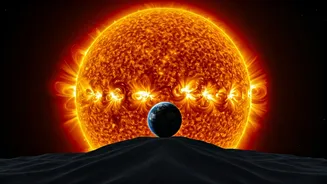
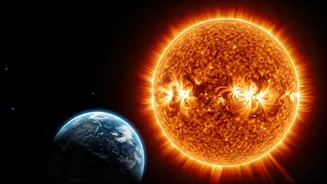
The short answer is yes, the statement is not just true, it's actually an understatement. If you were to treat both the Earth and the Sun as empty containers and fill the Sun with the volume of the Earth, you’d need about 1.3 million Earths to do the job.
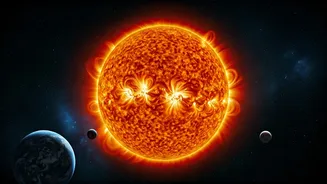
The Sun's diameter is roughly 865,000 miles, while the Earth's is a comparatively tiny 7,917 miles. But the real magic happens when you calculate volume. Because volume increases with the cube of the radius, the Sun’s vast diameter gives it a truly colossal internal space. The Sun isn't just bigger than Earth—it's bigger on a scale that defies our everyday intuition. It contains more than 99.8% of the total mass in our entire solar system. Everything else—all the planets, moons, asteroids, and comets—is just leftover cosmic dust by comparison.
The Cosmic Packing Problem
So why do people say “one million” when the number is closer to 1.3 million? This is where it gets fun. The 1.3 million figure assumes you could melt down all the Earths into a liquid and pour them into the Sun, filling every nook and cranny. But what if you had to pack them in as solid spheres? Think of a gumball machine. No matter how you shake it, there will always be empty spaces between the gumballs. This is known as the sphere-packing problem. When physicists and mathematicians calculate for this wasted space, the number of Earths you could fit inside the Sun drops to around 960,000. So, the common “one million” figure is actually a fantastic average—a convenient and memorable number that perfectly splits the difference between a liquid-volume and a solid-sphere reality. It's the perfect back-of-the-napkin estimate for an impossibly large number.
Bringing the Scale Down to Earth
Numbers like 865,000 miles and 1.3 million are too large for our brains to truly process. To get a better feel for it, let's use an analogy. If you were to shrink the Earth down to the size of a standard marble (about half an inch in diameter), how big would the Sun be on that same scale? It wouldn't be a basketball or even a beach ball. It would be a colossal sphere nearly 50 feet wide—roughly the height of a four-story building. Imagine a single marble sitting in the cavernous space of a four-story-tall sphere. That’s the relationship between our world and our star. Another way to think about it: if the Sun were the size of a standard front door, the Earth would be the size of a nickel. Now imagine trying to fill that entire doorway with nothing but nickels. You start to get a visceral sense of the scale.
It's Not Just About Size
The Sun’s dominance isn’t just about volume; it’s about its very nature. The Sun isn't a rocky planet like ours. It's a star—a raging ball of superheated gas, primarily hydrogen and helium, held together by its own immense gravity. The core of the Sun is a place of unimaginable pressure and temperature, reaching over 27 million degrees Fahrenheit. This is where nuclear fusion occurs, the process that generates the light and heat that make life on Earth possible. Every second, the Sun converts about 600 million tons of hydrogen into helium, releasing a torrent of energy that radiates across the solar system. So when we say 1.3 million Earths could 'fit' inside, we're comparing our solid, rocky home to a celestial furnace of truly epic proportions. It's like comparing a grain of sand to a volcano.