





What Exactly Is a Neutron Star?
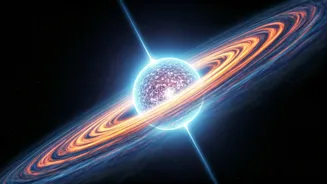
Before you get the spin, you have to understand the object. A neutron star is the ghost of a giant. It’s what’s left after a massive star, one much larger than our sun, runs out of fuel and explodes in a supernova. While the outer layers of the star are
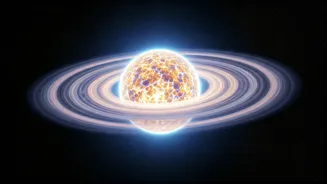
blasted into space, the star's core collapses under its own immense gravity. Protons and electrons are squeezed together so violently that they merge to form neutrons, hence the name. The result is an object of almost unimaginable density. A typical neutron star might only be 12 miles across—about the size of Manhattan—but it packs in more mass than our entire sun. A single sugar-cube-sized piece of neutron star material would weigh about 100 million tons on Earth. It is the densest observable object in the universe, second only to the theoretical singularity inside a black hole.
The Cosmic Ice Skater Effect
So, why the incredible speed? The answer lies in a fundamental law of physics: the conservation of angular momentum. Think of an ice skater spinning with her arms outstretched. As she pulls her arms in, her spin gets dramatically faster. The same principle applies to a collapsing star. Before the supernova, the massive star was rotating, perhaps very slowly—maybe once every few weeks. But as its core collapses from a diameter of millions of miles down to just a dozen, that rotational energy has to go somewhere. With its mass now packed into an incredibly small radius, the star’s rotational speed skyrockets. The slow, lumbering spin of the original star is concentrated into the frantic, dizzying whirl of the resulting neutron star. This cosmic ice skater effect is what transforms a slow rotation into a spin rate of hundreds of times per second.
A Lighthouse in the Cosmic Fog
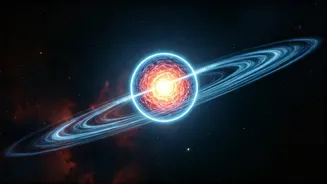
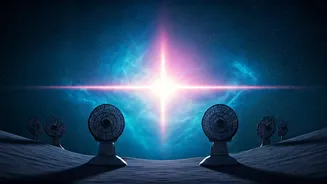
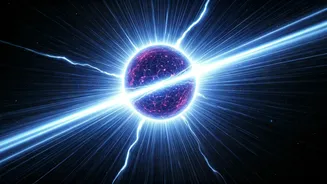
Stating that something spins 600 times a second is one thing, but how could we possibly know that from trillions of miles away? We don’t “see” them spin directly. Instead, we detect them as pulsars. Neutron stars have incredibly powerful magnetic fields that channel jets of radiation—like radio waves, X-rays, and gamma rays—out from their magnetic poles. These poles are rarely aligned with the star’s rotational axis. As the neutron star spins, these beams of energy sweep across the cosmos like the light from a lighthouse. If one of these beams happens to sweep past Earth, our radio telescopes pick up a regular, repeating pulse. By timing these pulses with atomic-clock precision, astronomers can calculate the star's rotation period with breathtaking accuracy. The fastest of these, known as millisecond pulsars, are the ones that reach speeds of 600, and in some cases, over 700 rotations per second.
What That Speed Really Means
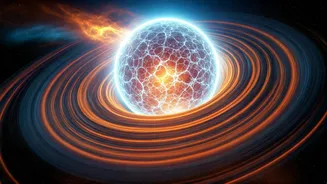
Let’s put that number in perspective. A typical kitchen blender blade spins at around 300 times per second. A high-performance car engine might top out at 150 revolutions per second. A neutron star spinning at 600 times per second means a point on its equator is moving at a significant fraction of the speed of light—roughly 20%, or about 40,000 miles per second. This extreme rotation has physical consequences for the star itself. The centrifugal force is so immense that the star bulges at its equator, becoming slightly flattened like a squashed ball. This incredible speed is also its eventual doom. As the pulsar radiates energy away, it slowly loses rotational momentum over billions of years, eventually slowing to a crawl and becoming a cold, dark, and silent ball of neutrons, forever drifting through the cosmic graveyard.