







An Unstable Foundation
Mumbai is a city of numerous hills, many of which are composed of jointed rock and loose soil. Geologically, these slopes are naturally prone to instability. The rock mass is fractured, and the topsoil is often a weak, silty clay that has poor shear strength.
This composition means that when gravitational forces acting on the slope exceed its natural resistance, failure is a real possibility. Even without human interference, the terrain in areas like Ghatkopar, Kurla, and Malabar Hill is inherently susceptible to erosion and collapse, a fact that has been documented for years.
The Monsoon's Destructive Power
The primary trigger for these landslides is the intense and prolonged rainfall during the monsoon season. A warmer atmosphere, influenced by climate change, can hold more moisture, potentially leading to the kind of extreme rainfall events that have been hitting Mumbai. This relentless rain saturates the already weak soil and percolates deep into the ground. The increased water pressure within the soil, known as pore-water pressure, effectively lubricates the particles, reducing friction and causing the slope to lose its stability and fail catastrophically.
Urban Pressures and Unchecked Growth
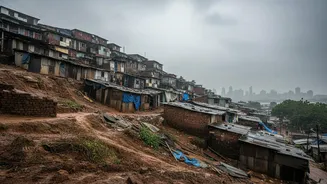
The problem is severely magnified by human activity. Mumbai's immense population density and the critical shortage of affordable housing force many of its poorest residents to build homes in high-risk areas, including on and at the base of these unstable hills. These informal settlements, or slums, are often densely packed and built without adherence to any safety regulations. Reports have shown that a staggering 70% of Mumbai's landslide-prone locations are within these informal settlements, highlighting the disproportionate risk faced by the city's most vulnerable populations.
The Dangers of Cutting and Clearing
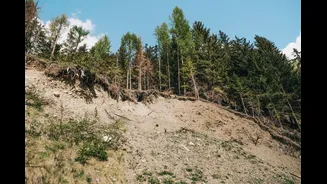
The very act of building on these slopes makes them more dangerous. To create flat ground for construction, hillsides are often cut into, a practice that removes the natural support at the base of the slope. Furthermore, widespread deforestation and the clearing of vegetation to make way for homes removes the root systems that naturally bind the soil together. This combination of undercutting the slope and removing its natural anchors leaves the hillside critically weakened and primed for collapse when the rains arrive.
A Failure of Planning and Policy
Despite repeated warnings and deadly incidents, effective preventative action has been slow. Reports from as far back as 2018 by the Geological Survey of India (GSI) identified specific, highly vulnerable slopes and recommended mitigation measures like retaining walls and proper drainage. However, many of these measures remain incomplete. The GSI noted that changes to slope geometry and land use patterns aggravate the risk, calling for a clear land-use policy that has yet to be fully implemented. The continued presence of illegal construction, sometimes with access to civic amenities, allows settlements to expand further into danger zones.