





A Planet Found in the Shadows
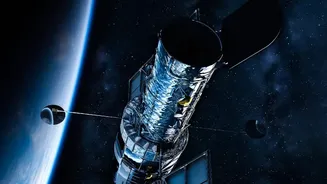
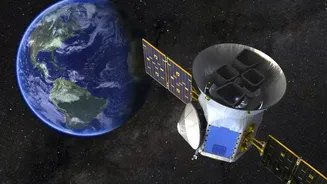
About 1,000 light-years from Earth, the planet known as TOI-2535 b was never seen directly. Instead, astronomers using NASA's Transiting Exoplanet Survey Satellite (TESS) detected it through the transit method. This clever technique involves monitoring
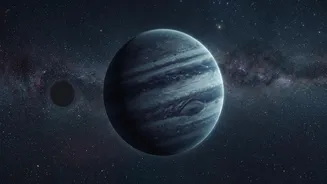
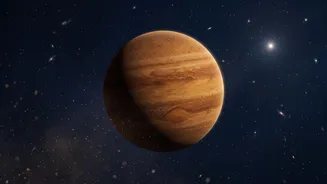
a star's brightness over time. When a planet passes in front of its star from our perspective, it blocks a tiny fraction of the light, causing a slight, temporary dip. For years, TESS observed these regular dips from the TOI-2535 system, revealing a massive planet. Classified as a 'hot Jupiter', TOI-2535 b is a gas giant similar in size to our own Jupiter but orbits its star at an incredible speed. It completes a full 'year' in just 8.25 Earth days, hugging its star much closer than Mercury orbits our sun.
An Orbit That Lost Its Rhythm
While planetary orbits are often thought of as clockwork, TOI-2535 b's was anything but. Soon after its discovery, scientists noticed that its transits were unreliable. The planet would arrive at its scheduled crossing sometimes as much as six hours early or six hours late. This kind of significant timing variation is a major red flag for astronomers. In a simple, one-planet system, orbits are remarkably stable. Such a large deviation suggested something else was at play in the system, a hidden influence pulling and pushing on the planet and disrupting its schedule. Over the course of seven years of observation, from 2019 to 2026, these irregularities continued, alongside another worrying trend: the transits themselves were changing.
The Vanishing Act
The mystery deepened as astronomers watched the planet's signal begin to fade. With each passing orbit, the dips in starlight caused by TOI-2535 b became shorter and shallower. It was as if the planet was shrinking or becoming transparent. Then, in March 2026, the signal disappeared entirely. TESS scanned the star system, but the tell-tale dip in brightness was gone. The planet had, for all intents and purposes, vanished. This was an unprecedented event; it was the first time scientists had directly observed a confirmed planet's transits cease completely. Planets don't just blink out of existence, so the scientific community had to solve the puzzle of where it went.
A Hidden Cosmic Dance Partner
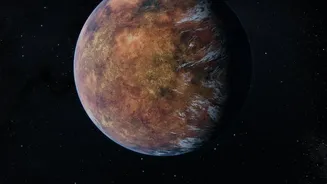
The planet hadn't been destroyed or thrown from its system. The solution was found in the clues it left behind: the erratic timing and the fading transits. Scientists concluded that TOI-2535 b is not alone. An unseen planetary companion is locked in a gravitational tug-of-war with it. The gravity of this hidden neighbor, likely a giant planet itself, is pulling on TOI-2535 b, causing its orbit to tilt. The two planets' orbits are wobbling like spinning tops, a phenomenon known as precession. Over seven years, this wobble tilted TOI-2535 b's orbit just enough that, from our viewpoint on Earth, it no longer passes in front of its star. The planet is still there, completing its eight-day orbit, but it now passes just above or below the star from our line of sight.
Rewriting the Rules of Planet Formation
This disappearing act is more than just a cosmic magic trick; it provides crucial insights into how planetary systems form. Hot Jupiters like TOI-2535 b have long puzzled scientists because they are found so close to their stars, where it's thought they couldn't have originally formed. One theory is that they are flung inward after a violent gravitational event, like a near-collision with another planet. However, the stable, interactive dance between TOI-2535 b and its neighbor suggests a different story. This pairing indicates a calmer formation history, where the planets may have formed farther out and slowly migrated inward together. This system is a rare laboratory for studying planetary evolution in action.