




The Ultimate Ejection Seat
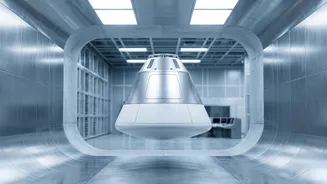
Think of the Crew Escape System (CES) as the most sophisticated ejection seat ever built. Instead of ejecting a single pilot from a fighter jet, this system is designed to pull the entire astronaut-carrying Crew Module away from its launch vehicle in milliseconds
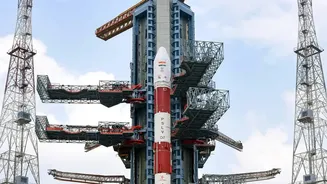
if a critical failure is detected. This powerful system is a lattice-like structure that sits atop the capsule, often called an escape tower. It is equipped with its own set of powerful, quick-acting solid rocket motors, ready to fire at a moment's notice to save the crew. The system continuously monitors the health of the launch vehicle, and an autonomous computer can trigger an abort if it detects any dangerous deviation, from a loss of thrust to a structural problem.
Anatomy of a High-Speed Escape
The Gaganyaan CES is a marvel of engineering, comprising several types of solid motors designed for different abort scenarios. The primary engines are the High-Thrust Escape Motors, which provide the immense power needed to rapidly separate from a malfunctioning rocket. Then, Pitch and Jettisoning Motors work to control the trajectory, steering the Crew Module away from the rocket's path and then discarding the escape tower once its job is done. This entire sequence happens in a flash. In the event of an emergency, pyrotechnic devices sever the connections holding the Crew Module to the rocket. The escape motors ignite, accelerating the astronauts away at forces up to 10 Gs—a demanding but survivable experience. This rapid acceleration is crucial to outrun any potential explosion from the main launch vehicle.
Two Critical Scenarios
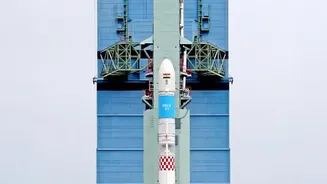
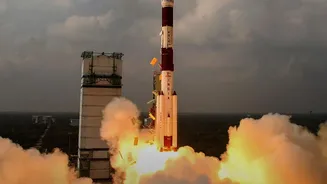
ISRO has designed and tested the CES for two primary failure situations. The first is a 'Pad Abort', which addresses an emergency on the launchpad before or during ignition. In July 2018, ISRO successfully conducted a Pad Abort Test, where the system lifted a 12.6-tonne simulated crew module, fired its motors, and flew to an altitude of 2.7 km before splashing down safely in the Bay of Bengal. The second, more complex scenario is an 'In-flight Abort'. This was demonstrated in the TV-D1 mission in October 2023. This test simulated a failure during the ascent, at an altitude of about 17 km and travelling at Mach 1.2, the point of maximum aerodynamic pressure. The CES successfully pulled the module away from the test vehicle, demonstrating its capability under the most stressful conditions of a launch.
From Separation to Splashdown
Once the escape motors have propelled the Crew Module to a safe distance and altitude, the rest of the safety sequence unfolds. The escape tower itself is jettisoned from the capsule. The Crew Module then begins its descent. A complex sequence of ten parachutes is deployed to slow the module down. First, two apex cover parachutes deploy, followed by two drogue parachutes to stabilize the craft. Finally, three pilot chutes pull out the three main parachutes, which drastically reduce the speed for a gentle splashdown into the sea. As seen in the TV-D1 test, the module is designed to float until it can be retrieved by recovery teams from the Indian Navy, bringing the abort sequence to a safe conclusion.