



A Chemical Surprise at the Galaxy's Heart
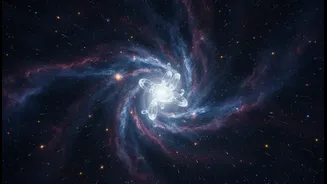
Scientists have long studied the dense clouds of gas and dust at the centre of our galaxy, known as the Central Molecular Zone. This region, surrounding the supermassive black hole Sagittarius A*, is a cosmic factory where stars are born. Using powerful
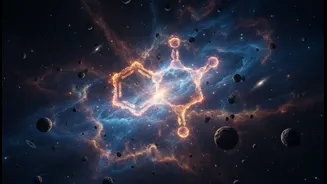
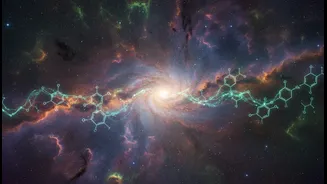
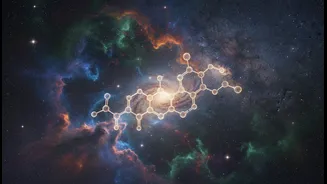
radio telescopes, researchers have recently identified an impressive inventory of organic molecules floating within these clouds. Among the most exciting finds is a simple sugar called erythrulose, a four-carbon molecule also found in raspberries, detected for the first time in interstellar space. Other discoveries include a variety of nitriles, which are considered key precursors for RNA, a fundamental molecule for life. Astronomers have also catalogued molecules like methanol, acetone, and ethanol, indicating a surprisingly complex chemical environment. The presence of these carbon-based compounds, the building blocks of life as we know it, in such a turbulent place challenges previous assumptions about where prebiotic chemistry can occur.
The Turbulent Neighbourhood of the Galactic Core
Finding these molecules near the galactic centre is significant because it's one of the most hostile environments in the Milky Way. The region is flooded with intense radiation and powerful cosmic rays, and the immense gravitational pull of the supermassive black hole creates extreme conditions. It was once thought that such an environment would be too harsh for complex molecules to form and survive. However, the latest findings suggest the opposite might be true. Some researchers now believe that the very conditions that make the galactic core so extreme, such as the prevalence of cosmic rays, may actively drive chemical complexity. These high-energy particles can collide with larger carbon-rich materials, breaking them down and releasing a diverse array of smaller organic molecules into the surrounding gas, fueling a rich chemical network.
Telescopes Peering Through the Cosmic Dust
These discoveries would not be possible without cutting-edge technology. Telescopes like the Atacama Large Millimeter/submillimeter Array (ALMA) in Chile and the James Webb Space Telescope (JWST) have given us an unprecedented view into these dust-shrouded regions. They operate at wavelengths of light that are invisible to the human eye, allowing them to pierce through the dense clouds of gas and dust that obscure the galactic centre. By analysing the specific light signatures, or spectra, emitted or absorbed by the clouds, astronomers can identify the chemical fingerprints of different molecules. This technique, known as spectroscopy, has been instrumental in creating a detailed inventory of the chemical ingredients present in these stellar nurseries. For example, recent observations have identified not just simple compounds but also molecules with branched carbon structures, which are a key characteristic of amino acids, the building blocks of proteins.
Connecting the Dots to the Origin of Life
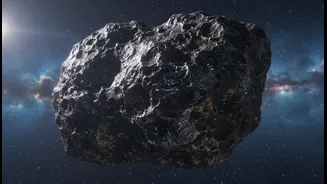
So, what does this all mean for cosmic evolution and the search for our origins? The discovery of abundant and complex organic molecules in the star-forming regions of our galaxy strongly supports the idea that the ingredients for life are common throughout the universe. This doesn't mean we've found life, but it does show that the fundamental chemical precursors can be synthesized naturally in space, even before planets form. The theory is that these molecules become incorporated into asteroids and comets. These celestial bodies then act as cosmic delivery vehicles, seeding young planets like the early Earth with the organic materials necessary for life to emerge. Each new molecular discovery near the galactic centre adds another piece to this fascinating puzzle, suggesting that the story of life on Earth may have its earliest chapters written among the stars at the heart of the Milky Way.