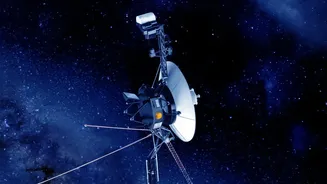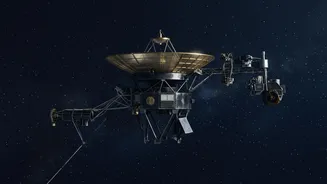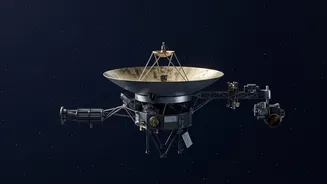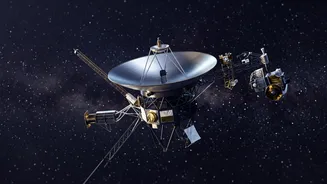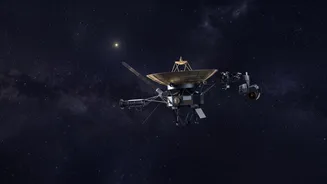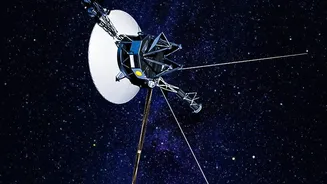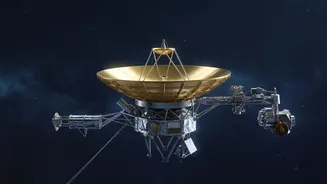



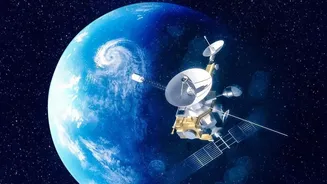
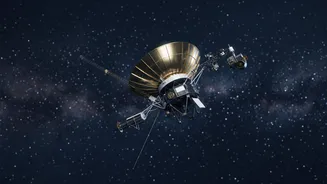
On November 18, 2026, a machine launched when bell-bottoms were in style will achieve something unprecedented. NASA’s Voyager 1 probe will be one light-day from Earth, a distance so vast it reaffirms its status as humanity's farthest emissary.
A Mind-Bending Milestone
What exactly
is a light-day? It isn't a measure of time, but of distance: the colossal stretch that light, the universe’s ultimate speedster, covers in 24 hours. That's approximately 25.9 billion kilometres, or about 173 times the distance between the Earth and the Sun. On November 18, when Voyager 1 crosses this threshold, it will be so far away that a radio signal sent from NASA’s Deep Space Network will take a full day to reach it. Any reply would take another day to return, meaning a simple 'hello' and its answer would span two full days. This milestone isn't a physical boundary in space, but a human one—a profound marker of the incredible gulf Voyager 1 has crossed since it left Earth nearly 50 years ago.
A Journey for the Ages
Launched on September 5, 1977, just weeks after its twin, Voyager 2, the probe's original mission was to explore the outer planets. Taking a faster, more direct route, Voyager 1 overtook its sibling and conducted breathtaking flybys of Jupiter in 1979 and Saturn in 1980. Its observations were revolutionary, discovering active volcanoes on Jupiter’s moon Io, revealing Jupiter’s faint ring system, and providing the first detailed images of Saturn’s complex rings and its hazy moon, Titan. After its planetary tour, its trajectory flung it upwards, out of the plane of the solar system, on a one-way trip toward the stars. On February 17, 1998, it officially became the most distant human-made object in existence, surpassing the Pioneer 10 probe.
Into the Interstellar Void
The mission's most historic chapter began in August 2012, when Voyager 1 crossed the heliopause—the boundary where the Sun’s solar wind gives way to the interstellar medium. It had officially entered the space between stars, the first object made by humans to do so. Since then, it has been humanity’s lone sentinel in the galactic wilderness, sending back invaluable data about an environment never before measured directly. Communicating with the aging craft has become a testament to engineering ingenuity. Mission controllers have battled failing memory chips and a dwindling power supply from its plutonium generators to keep it alive. Despite these challenges, and travelling at nearly 61,000 kilometres per hour, Voyager 1 continues its lonely journey.
A Message in a Cosmic Bottle
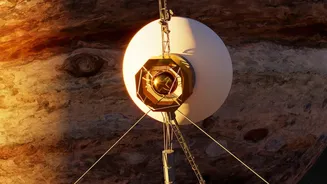
Bolted to Voyager $#$ side is a more poetic part of its mission: the Golden Record. This $#$ inch,$#$ gold-$#$plated copper disk is a time capsule,$#$ curated by a team led by famed astronomer Carl Sagan. It contains $#$ images,$#$ natural sounds from Earth like wind and whale songs,$#$ musical selections from Bach to Chuck Berry,$#$ and spoken greetings in $#$ languages. The record's cover includes a diagram showing how to play it and a map pinpointing our solar system's location relative to $#$ pulsars. It was launched with the hopeful,$#$ if improbable,$#$ idea that it might one day be found by an advanced extraterrestrial civilization. It is a message of peace,$#$ a portrait of our world frozen in $#$77. Long after its instruments fall silent,$#$ the Golden Record will continue its silent journey,$#$ a testament to the species that sent it.