




The Unforgiving Lunar Night
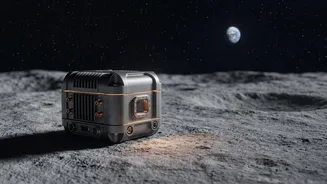
Exploring the Moon isn't as simple as driving a remote-controlled car. A lunar day and night each last for about 14 Earth days. While sunlit areas can get scorching hot, the long darkness brings a deep, penetrating cold. Temperatures can plummet to an astonishing
-173 degrees Celsius (-280 degrees Fahrenheit), with some permanently shadowed craters reaching as low as -248°C. For a sophisticated piece of machinery like a rover, this is a death sentence. Batteries lose their ability to hold a charge, sensitive electronics fail, and the physical stress of extreme temperature changes can cause components to crack and break. For solar-powered rovers, the long night means no energy generation, making it impossible to run electric heaters to stay warm.
A Simple, Steady Source of Warmth
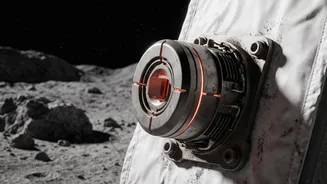
The solution to this freezing problem is remarkably simple and elegant: Radioisotope Heater Units, or RHUs. These are not complex machines. In fact, they have no moving parts at all. An RHU is a small, passive device, about the size of a C-cell battery, containing a pellet of a special material called Plutonium-238 (Pu-238). Each unit generates a small but continuous amount of heat—about one watt—not through any chemical reaction or electrical process, but from the natural decay of its fuel. By placing these small heaters near critical components like electronics and batteries, engineers can keep the rover's vital systems within their operational temperature range, even in the depths of the lunar night.
How It Works: The Power of Natural Decay
The science behind RHUs is rooted in fundamental physics. Plutonium-238 is a radioactive isotope, but it is not the kind used in weapons. Its nucleus is unstable, and over time, it naturally breaks down, or decays, into a more stable element. As it does, it releases energy in the form of alpha particles. These particles, composed of two protons and two neutrons, crash into surrounding atoms within the fuel pellet, creating friction and movement at a microscopic level. The collective result of these countless atomic collisions is a significant and steady output of heat. Because this process is a natural property of the material itself, it requires no input, no maintenance, and no sunlight, providing a reliable source of warmth for decades.
Enabling a New Era of Exploration
The ability to survive the lunar night transforms what is possible in space exploration. Instead of missions that last only a single, 14-day period of lunar daylight, rovers equipped with RHUs can operate for months or even years. This has been a key technology for numerous missions beyond Mars, including NASA's Mars rovers and deep space probes like Voyager and New Horizons. For the Moon, it means rovers can conduct long-term scientific investigations, continuously monitor the environment, and explore regions that were previously inaccessible. This capability is crucial for the ambitions of programs like Artemis, which aim to establish a sustained human presence on the lunar surface. Reliable power and heat are fundamental to building habitats, utilizing lunar resources, and creating a permanent foothold beyond Earth.
Beyond Heaters: Powering the Future
The same principle that powers RHUs can also be used to generate electricity. In larger devices called Radioisotope Thermoelectric Generators (RTGs), the heat from Pu-238 decay is used to create an electrical current. These systems work by using thermocouples, which generate voltage when there is a temperature difference across them. The hot side is attached to the radioisotope heat source, while the cold side faces the frigid environment of space, producing reliable electricity to power a rover's computers, wheels, and scientific instruments day and night. As agencies like NASA plan more ambitious missions to the Moon and beyond, this type of self-sufficient power technology, whether for simple heating or full electrical generation, remains an indispensable tool for exploring the cosmos.