





A Feast for Faith and Family
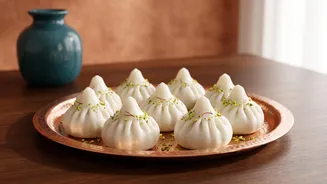
No story about Ganesh Chaturthi is complete without food, which serves as a language of devotion and community. The star of the festival is undoubtedly the modak, a sweet dumpling believed to be a favourite of Lord Ganesha. In kitchens across Maharashtra
and beyond, families gather to prepare ukadiche modak—steamed parcels of soft rice flour filled with a fragrant mixture of fresh coconut and jaggery. While the steamed version is a Maharashtrian classic, sweet shops offer fried varieties and modern interpretations with chocolate or mawa. But the festive menu extends far beyond a single sweet. It often includes Puran Poli, a sweet flatbread stuffed with lentils and jaggery, alongside savoury dishes like batata bhaji, varan bhaat (dal and rice), and crisp puris. The food prepared is typically sattvic, meaning it is made without onion, garlic, or meat, emphasizing purity and freshness. These meals are not just for consumption; they are offerings (bhog) and a way to share blessings with visiting friends and relatives, turning every home into a hub of culinary heritage.
Journeys of Devotion and Homecoming
Travel during Ganesh Visarjan week takes two primary forms: the pilgrimage home and the pilgrimage through the city. For many, the festival is a powerful reason to journey back to their hometowns, reconnecting with family for rituals and celebrations. This annual homecoming reinforces familial bonds and shared traditions. The other significant form of travel is local. In cities like Mumbai, Pune, and Hyderabad, 'pandal-hopping' is a cherished activity. Families and friends navigate crowded streets to witness the creative and often massive Ganesh idols housed in temporary structures called pandals. Mumbai is the epicentre of these celebrations, with landmark pandals like Lalbaugcha Raja drawing millions of visitors who wait in queues for hours just for a momentary glimpse. As the festival concludes, travel takes on a different dimension. Procession routes for the visarjan (immersion) become rivers of humanity, with devotees accompanying their idols to the nearest water body. Public transport is often the best way to navigate cities during this time, as roads are choked with joyful chaos. This collective movement is a powerful display of shared faith, turning an entire city into a single, moving celebration.
Culture in Full Colour
Beyond the kitchen and the commute, Ganesh Visarjan week is a vibrant expression of Indian culture. Historically, the festival was popularized by freedom fighter Bal Gangadhar Tilak as a way to unite people from all walks of life, and that spirit of community remains its cornerstone. The celebrations are a multi-sensory experience, filled with the beats of dhol-tasha drum troupes, devotional songs, and chants of “Ganpati Bappa Morya, Pudhchya Varshi Lavkar Ya,” which means "Oh Lord Ganesha, come again soon next year." The artistry on display is breathtaking, from the intricately crafted idols to the elaborate pandal decorations. In recent years, a new cultural story has emerged: the rise of eco-friendly celebrations. Many communities now opt for idols made from natural clay (shaadu maati) that dissolve easily in water, or even perform symbolic immersions at home to protect the environment. This evolution shows a culture that is not static but is adapting its traditions to modern sensibilities while preserving the core spiritual meaning—the idea that all forms are temporary and that life is a continuous cycle of creation and dissolution.
The Bittersweet Farewell
The final act of the festival, the visarjan, is a deeply emotional and symbolic event. Depending on family tradition, idols are immersed after one and a half, three, five, seven, or ten days. The last and largest day of immersion falls on Anant Chaturdashi. As families carry their idols in procession, the atmosphere is a mix of joyous celebration and the sadness of farewell. The immersion itself represents Lord Ganesha's return to his celestial abode, taking with him the obstacles of his devotees. The act of letting the idol dissolve back into the elements is a profound reminder of the impermanence of life and the importance of detachment. Yet, it is not an end. The chants for his return next year transform the goodbye into a hopeful promise. After the music fades and the crowds disperse, a quietness settles in. The empty corner where the idol once sat serves as a silent testament to the memories made, the food shared, and the journeys taken—stories that will be told until it's time to welcome him home again.