







The Monsoon’s High-Stakes Gamble
The Indian summer monsoon is the lifeblood of the nation's agriculture, with nearly half of the population dependent on it for their livelihood. The timing and distribution of these seasonal rains dictate the success or failure of crops, influencing the economy
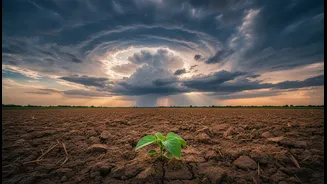
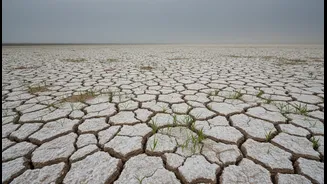
at a massive scale. For millions of smallholder farmers, decisions like when to sow seeds, apply fertilizer, or schedule irrigation are made with one eye on the sky and the other on tradition. However, climate change is making the monsoon increasingly erratic and hard to predict, turning this annual cycle into an even riskier venture. An unexpected dry spell after planting can wipe out a farmer's entire investment in seeds and inputs, creating a classic catastrophe scenario.
The Old Way of Forecasting
For decades, weather prediction has relied on Numerical Weather Prediction (NWP) models. Run on powerful supercomputers, these systems use the laws of physics and thermodynamics to simulate the Earth's atmosphere. The India Meteorological Department (IMD) uses these complex models to provide broad guidance. While these systems have improved over the years, they are computationally expensive and have limitations. They struggle to provide reliable, detailed forecasts beyond five to seven days, and their accuracy at a very local, or 'hyperlocal', level can be limited. For a farmer needing to know if it will rain in their specific block or village next week, this isn't always enough.
How AI Changes the Game
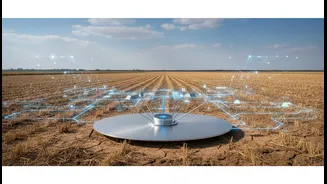
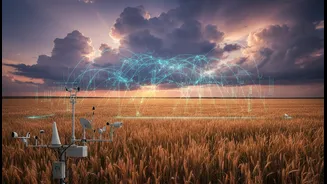
Artificial intelligence models work differently. Instead of trying to solve countless complex physics equations from scratch, they are trained on decades of historical weather data, learning to recognize patterns that precede certain weather outcomes. Companies like Google have developed models such as NeuralGCM and GraphCast, which can generate forecasts thousands of times faster than traditional methods, sometimes on a single laptop. This approach allows for more accurate predictions for longer lead times. In a landmark initiative, a blended model developed by the University of Chicago and using Google's AI was used to provide monsoon forecasts to 38 million Indian farmers. This system successfully predicted the monsoon's onset up to a month in advance, even capturing an unusual 20-day stall in the rains that traditional models missed.
Real-World Impact for Farmers
More accurate, long-range forecasts are a game-changer. They empower farmers to move from reactive to proactive planning. With a reliable 15- or 30-day forecast, a farmer can make much smarter decisions. If the forecast is for a longer-than-expected growing season, they might invest more in cash crops, increase the amount of land they cultivate, and apply more fertilizer. Conversely, if a delayed monsoon and shorter season is predicted, they might switch to less water-intensive crops, reduce spending on inputs, or even seek off-farm work. In May 2026, the IMD launched its own AI-enabled systems, including one to predict the monsoon's advance at the block level and a pilot in Uttar Pradesh for rainfall forecasts with a 1-kilometre resolution. This level of local precision helps with precise planning around sowing, irrigation, and harvesting.
The Last-Mile Challenge
Developing a powerful AI model is only half the battle. The biggest challenge lies in making this valuable information usable for every farmer. In the successful large-scale pilot, forecasts were delivered via SMS in partnership with the Ministry of Agriculture and Farmers' Welfare, showing that existing infrastructure can be leveraged effectively. However, ensuring this information reaches the most remote areas requires overcoming hurdles in digital literacy and connectivity. Furthermore, AI models are only as good as the data they are trained on. While India has good basic meteorological data, there are gaps, particularly in complex terrains like the Himalayas. Experts stress the need for a robust data infrastructure and a larger pool of professionals skilled in both meteorology and AI to ensure these models are continuously improved and validated against local conditions.