






A Landmark Discovery in Deep Space
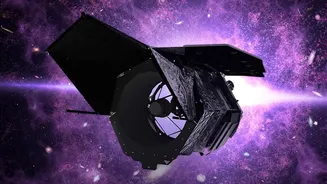
In a breakthrough for exoplanet science, researchers using the James Webb Space Telescope (JWST) have found compelling evidence of an atmosphere around a rocky 'super-Earth' 41 light-years away. The planet, known as 55 Cancri e, has long been an object
of fascination, but this is the strongest indication yet that such a world can sustain a significant gaseous envelope. While previous studies hinted at an atmosphere, the JWST's advanced capabilities have provided a much clearer picture. The data suggests an atmosphere that could be rich in gases like carbon dioxide or carbon monoxide, which may have bubbled up from a vast, planet-wide ocean of molten rock. This finding is a monumental proof-of-concept for the telescope, demonstrating its power to characterize planets outside our solar system.
What Exactly is a 'Super-Earth'?
The term 'super-Earth' refers to a class of exoplanet with a mass higher than Earth's but significantly lower than that of our solar system's ice giants, Neptune and Uranus. These planets can be rocky, like Earth, or have a combination of rock and gas. Super-Earths are one of the most common types of planets found in our galaxy, yet curiously, our own solar system doesn't have one. This makes them a key focus for astronomers. Their size and mass mean they have a better chance of holding onto an atmosphere than smaller planets, which is a crucial ingredient for potential habitability. The planet 55 Cancri e, for instance, has a diameter almost twice that of Earth and is about eight times as massive, placing it firmly in this intriguing category.
How JWST Peered into Another World
Detecting the whisper-thin atmosphere of a distant, rocky world is a staggering technological feat. The JWST achieved this using a technique called transmission spectroscopy. As 55 Cancri e passed in front of its host star, the telescope meticulously measured the starlight filtering through the planet's atmosphere. Different gases absorb specific wavelengths, or colours, of light. By analysing the subtle dips in the light spectrum, scientists can identify the chemical fingerprints of the molecules present. The team used both the Near-Infrared Camera (NIRCam) and the Mid-Infrared Instrument (MIRI) to build a comprehensive profile, allowing them to distinguish the planet's atmospheric signals from the star itself.
A Molten World, Not a New Earth
While the detection of an atmosphere is exciting, it’s important to understand that 55 Cancri e is no paradise. This super-Earth orbits its star so closely that a single year lasts less than 18 hours. Its surface is a scorching hellscape, likely covered in a global ocean of lava with temperatures high enough to melt rock. The planet is far too hot to be habitable in any way we can imagine. So, why is this discovery so important? Because it proves that even under extreme conditions of intense stellar radiation, a rocky planet can maintain an atmosphere. Scientists theorize the very magma ocean that makes the planet so inhospitable may be what's replenishing its atmosphere, with gases constantly bubbling out from the molten interior.
A Stepping Stone to Finding Life
The findings from 55 Cancri e are less about this specific world and more about what they mean for the future of astronomy. By successfully analysing the atmosphere of this challenging target, the JWST has proven it has the capability to study cooler, more temperate rocky planets. This is a critical step in the ultimate search for life beyond Earth. Each exoplanet studied provides another piece of the puzzle, helping scientists understand the conditions that make a planet habitable. This technological success opens the door to studying other rocky worlds, including those within their star's 'habitable zone,' where conditions might be right for liquid water to exist. This is not the discovery of an Earth-like world, but it is a vital milestone on the path to finding one.