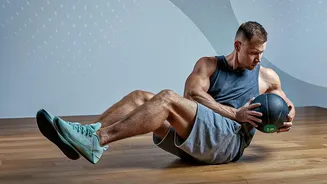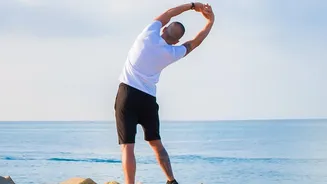




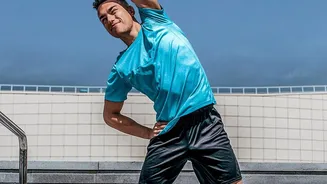
The standing torso twist is a core-strengthening staple, but are you doing it right? The secret to unlocking its true benefits lies in one crucial detail: keeping your hips locked in place. Here’s how to master the move for maximum effect.
Why Hip Stability Is the Secret
The primary
goal of a standing torso twist is to strengthen your obliques, the muscles running along the sides of your waist. To effectively isolate these muscles, the rotation needs to originate from your mid-section, not your lower body. When your hips swing along with your shoulders, you're using momentum rather than muscle. This not only reduces the exercise's effectiveness but can also place unnecessary strain on your lower back. By learning to stabilize your pelvis and keep your hips facing forward, you force the obliques to do the work, leading to a stronger core and better posture. The twist should happen in your thoracic spine (mid-back), not by torquing your hips and lumbar spine.
The Common Mistake: Swinging vs. Twisting
Many people perform standing twists by letting their entire lower body follow the movement of their arms and shoulders. This turns a controlled core exercise into a full-body swing. The movement should be deliberate and controlled, not fast and loose. If you feel your hips and legs moving significantly, you're relying on momentum. A proper twist involves creating tension in your core to rotate your upper body while the lower body acts as a stable anchor. Think of your body from the waist down as being set in concrete, allowing only your torso to move. This distinction is key to preventing injury and ensuring the right muscles are engaged.
Tip 1: Anchor Your Stance
Proper form begins from the ground up. Stand with your feet shoulder-width apart and a slight bend in your knees. This creates a solid and stable base. Before you even begin to twist, actively engage your core by bracing your abdominal muscles, as if you're about to be punched in the stomach. This contraction is fundamental to protecting your spine and providing the stability needed to isolate the twisting motion to your torso. Imagine a straight line running from the crown of your head down through your body; your goal is to rotate around this central axis without losing your posture.
Tip 2: Use the 'Headlights' Cue
A powerful mental cue is to imagine your two hip bones are headlights on a car. Your goal is to keep these headlights pointing directly forward at a wall in front of you throughout the entire exercise. As you twist your upper body to the right, fight the urge to let the 'headlights' turn with you. This visualization helps create the necessary dissociation between your upper and lower body. It forces you to control the movement from your waist and prevents your pelvis from rotating along for the ride. Practice this in front of a mirror to get instant visual feedback on whether your hips are staying square.
Tip 3: Actively Squeeze Your Glutes
Another highly effective technique for locking your hips in place is to actively squeeze your gluteal muscles. Contracting your glutes helps to stabilize your pelvis and prevents it from swaying or rotating. This engagement creates a powerful anchor in your lower body, making it much easier to isolate the twist in your torso. When you combine glute activation with a braced core, your lower body becomes a rigid platform, ensuring that the work is being done entirely by your obliques. This simple action can dramatically improve the quality and effectiveness of the exercise.
Tip 4: Reduce Range and Slow Down
If you're struggling to keep your hips still, it's often because you're trying to twist too far, too fast. Prioritize form over a large range of motion. Reduce the degree of your twist to a point where you can maintain perfect hip stability. It's far more beneficial to perform a smaller, controlled twist than a large, sloppy one. As your core strength and control improve, you can gradually increase your range of motion. Slowing down the movement also forces your muscles to stay engaged throughout the exercise, eliminating the temptation to use momentum. Focus on the feeling of your obliques contracting with each rotation.