
The North Pole Has a Famous Hexagon
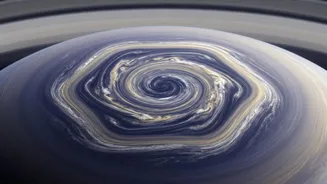
For decades, the undisputed star of Saturn's weather has been the north polar hexagon. First spotted by the Voyager spacecraft in the early 1980s, this six-sided jet stream is a remarkably persistent feature. It’s a storm of immense proportions, measuring
about 32,000 kilometres wide — so large that you could fit nearly four Earths inside it. The sides of the hexagon are each about 14,500 kilometres long. Unlike a hurricane on Earth that drifts and dissipates, Saturn’s hexagon is a stable wave in a powerful jet stream, with winds whipping around at speeds of about 320 kilometres per hour. Perhaps most strangely, the hexagon itself hardly moves; it rotates at almost the same speed as the planet's own interior, keeping it locked in place at the pole.
The South Pole Has a New Decagon
Until recently, the hexagon was thought to be a complete one-off. But in a major discovery announced in September 2026, scientists confirmed a new geometric storm at the south pole: a ten-sided decagon. This feature was a total surprise. NASA’s Cassini spacecraft orbited Saturn from 2004 to 2017 and saw no such polygon. Scientists now believe the structure formed sometime between 2017, when the Cassini mission ended, and 2023, when the Hubble Space Telescope first captured signs of it. The southern decagon is even larger than its northern counterpart, with a width of over 167,000 kilometres. Unlike the stable hexagon, the decagon appears to be a younger, evolving wave that is slowly drifting eastward, giving astronomers a rare chance to see a planetary polygon in the making.
These Shapes Are Giant, Fast-Moving Jet Streams
These polygons are not solid objects but are outlines of powerful jet streams. The geometric shape is believed to arise from turbulence where atmospheric layers moving at different speeds meet. Scientists have even replicated this effect in labs by spinning a circular tank of liquid at varying speeds, which caused similar polygonal patterns to form in the fluid. Computer simulations suggest the process starts deep within the planet. Heat rising from Saturn’s interior, a process called deep thermal convection, creates powerful storms. These smaller vortices are thought to surround and effectively “pinch” the main polar jet stream, warping its path from a circle into a stable polygon like a hexagon or decagon.
The Poles Have Different Colours
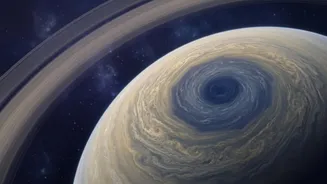
The two polar vortices don't just differ in their number of sides; they also have distinct colours. As Saturn's northern hemisphere tilted toward the Sun for its summer, the Cassini spacecraft observed the hexagon change colour from a hazy blue to a golden yellow between 2012 and 2016. Scientists believe this is due to the increased sunlight creating a kind of photochemical smog. On the other hand, recent Hubble images show the newly discovered southern decagon as having a distinctly blue hue. At the heart of both geometric storms, however, lies a similar feature: a massive, hurricane-like cyclone. The one at the north pole has an “eye” roughly 50 times wider than a typical hurricane eye on Earth.
They Prove Giant Planets are Ever-Changing
The hexagon's persistence for over 40 years gave an impression of stability. But the sudden appearance of the decagon has completely changed that view. It proves that the atmospheres of giant planets are incredibly dynamic and can generate continent-sized structures in just a few years. The discovery highlights just how much there is still to learn and why continuous observation is so critical. With the Cassini mission over, telescopes like Hubble are our primary eyes on the outer solar system. The decagon’s formation shows that far from being static, worlds like Saturn are active and capable of producing new wonders while we watch.