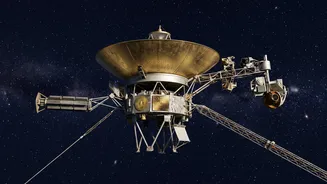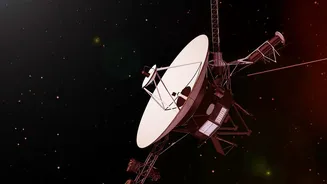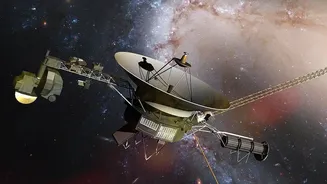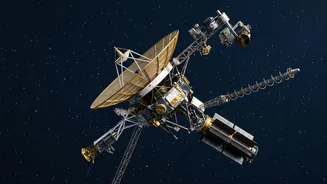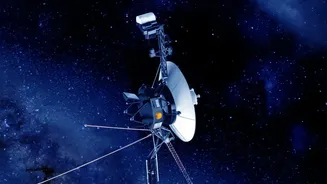


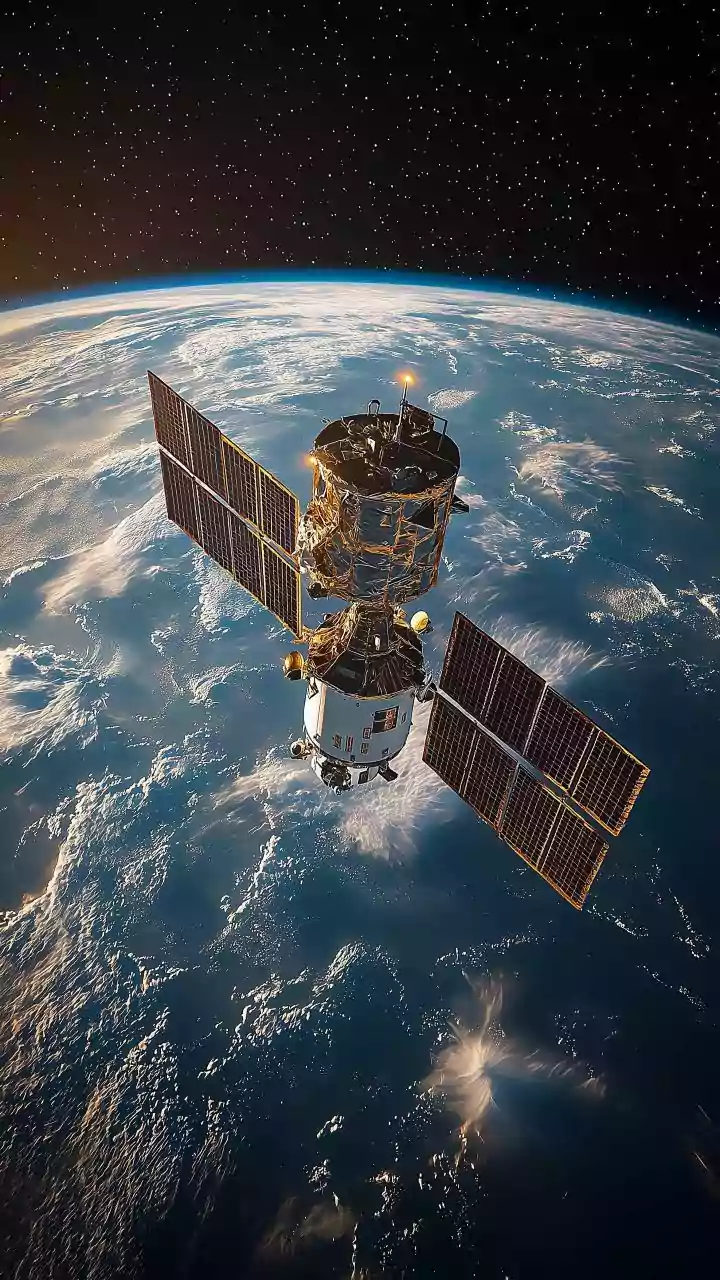
Humanity's most distant emissary, the Voyager 1 spacecraft, gave its creators a scare in October, falling silent for 48 hours. Now back in contact, the unexpected glitch highlights the incredible challenge of maintaining a 49-year-old probe.
A Worrying Silence From Deep Space
For two days
in October, there was nothing. On October 18 and 19, scheduled communication attempts by NASA's Deep Space Network—a global array of massive radio antennas—failed to detect a signal from Voyager 1. The probe, launched in 1977 and now more than 25 billion kilometres away, had gone quiet. For the engineers at NASA's Jet Propulsion Laboratory (JPL), it was a tense and unexpected development. At this stage of the mission, with the hardware nearly half a century old, any anomaly could potentially be the last. Then, on October 20, as suddenly as it had vanished, Voyager 1's signal reappeared, much to the relief of its terrestrial team. The spacecraft had restored contact on its own, before engineers could even send troubleshooting commands.
Diagnosing a Patient 48 Light-Hours Away
Figuring out what went wrong is a task of immense proportions. On November 18, 2026, Voyager 1 will reach a staggering milestone: a distance of one light-day from Earth. This means a radio signal, travelling at the fastest speed possible, takes a full 24 hours to reach the spacecraft. A round-trip message—a command from Earth and a response from the probe—takes two days. This communication lag turns diagnostics into a slow, deliberate process. Initial analysis suggests the spacecraft's fault-protection system kicked in as designed. Engineers have determined that one group of thrusters, which are used to keep the probe’s antenna pointed at Earth, went offline. In response, the spacecraft automatically switched to a backup set of thrusters, a pre-programmed safety measure for when the onboard computers detect a problem. While this explains the recovery, the root cause of the initial thruster issue is still under investigation.
Keeping an Interstellar Explorer Alive
This recent scare comes as the Voyager team celebrates another engineering feat: extending the probe's life. Both Voyager probes are powered by radioisotope thermoelectric generators (RTGs), which convert heat from decaying plutonium into electricity. This power source dwindles by about 4 watts each year, forcing engineers to make difficult choices about which systems to shut down. In a complex manoeuvre nicknamed the 'Big Bang', engineers in early September 2026 simultaneously swapped three power-hungry heating devices on Voyager 1 for more efficient alternatives. This crucial fix will delay the need to shut off another of the probe's remaining science instruments, potentially pushing that deadline from summer 2027 into the future. As of 2026, only two instruments remain active: the plasma wave subsystem and the magnetometer, which continue to send back invaluable data from interstellar space.
The Enduring Legacy of Voyager
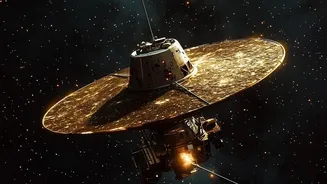
Voyager 1 and its twin, Voyager 2, are the only human-made objects to ever operate in interstellar space—the region beyond the protective bubble of particles and magnetic fields generated by our Sun. Launched on a grand tour of the outer planets, their missions have been extended for decades, returning fundamental discoveries about Jupiter, Saturn, and the very edge of our solar system. Even after its science instruments eventually fall silent, Voyager 1 will continue its journey. It carries a Golden Record, a gold-plated copper disc containing sounds and images selected to portray the diversity of life and culture on Earth, a time capsule for any civilization that might one day encounter it. The probe is traveling at over 61,000 kilometres per hour but will still take about 18,000 years to cover the distance of a single light-year. Its journey is a testament to human ingenuity and our unyielding curiosity to explore the unknown.