




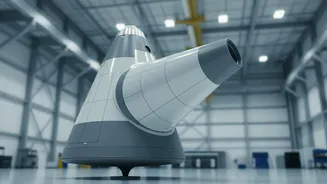

A Milestone for Gaganyaan
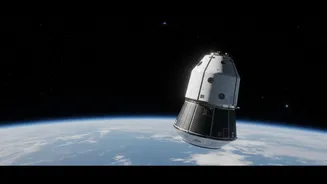
India’s ambitious human spaceflight program, Gaganyaan, achieved a landmark success with the flawless test of its Crew Escape System (CES). The high-altitude abort test was designed to prove that the system can safely pull the crew module away from the rocket
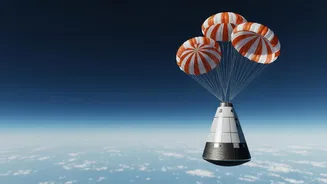
in the event of a catastrophic failure during ascent. This is one of the most dangerous phases of any space launch. In the carefully simulated emergency, the CES activated perfectly, its powerful motors firing to jettison the crew capsule to a safe distance before it deployed parachutes for a controlled splashdown in the Bay of Bengal. This successful demonstration is not just a technical victory; it is a vital confidence-booster, confirming that the safety of India's future astronauts, or 'Vyomanauts', is the highest priority.
Understanding the Crew Escape System
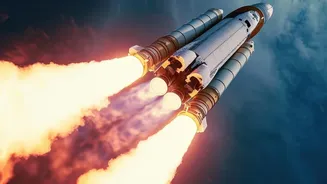
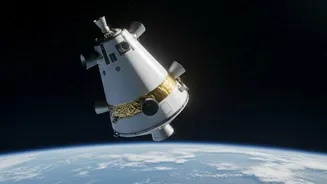
Think of the Crew Escape System as the ultimate ejection seat for a spacecraft. It's a non-negotiable safety feature for any human-rated mission, designed for one purpose: to save the crew if the rocket malfunctions on the launchpad or during its fiery climb through the atmosphere. The system sits atop the crew module and is armed with a set of powerful, quick-acting solid motors. If the rocket's advanced health monitoring system detects a critical problem, the CES fires with immense force, pulling the capsule and its occupants away from danger in milliseconds. ISRO's system is a 'puller' type, similar to those used on the historic Apollo and Soyuz missions, capable of generating an acceleration up to 10 times that of gravity to outpace a failing booster.
A High-Stakes Manoeuvre
While ISRO had previously tested the escape system from the launchpad in 2018 (a 'pad abort' test), this high-altitude test was far more complex and critical. It was conducted during the transonic phase of flight, when the launch vehicle is travelling at around the speed of sound. At this stage, the vehicle experiences maximum aerodynamic pressure, a point known as 'Max Q', making any anomaly extremely dangerous. Successfully proving the escape system works under these high-stress conditions is a monumental achievement. It validates the system’s design and demonstrates that the crew can be safely rescued during one of the most challenging moments of their journey to space. The successful test provides crucial data, ensuring the system performs as predicted when lives are on the line.
The Path to Sending Vyomanauts to Space
This successful test directly impacts the four astronaut-designates selected for the Gaganyaan mission. Every validated safety system brings them one step closer to their historic flight, which will make India only the fourth nation in the world to launch its own crewed space mission. These future Vyomanauts have undergone extensive training, including in Russia, and are preparing for a mission that will take them to a low-Earth orbit of about 400 kilometres for three days. The recent success of the escape system test is a tangible assurance of the robust safety protocols being put in place, underscoring ISRO's commitment to human safety above all else. It builds on a series of precursor missions and tests designed to make every aspect of the mission as reliable as possible before humans are on board.
What's Next for Gaganyaan?
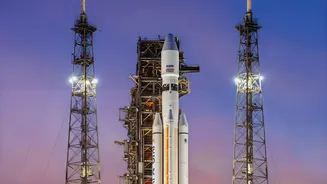
With this critical safety milestone achieved, the Gaganyaan program moves forward with greater confidence. The roadmap includes more test flights to validate other systems under different conditions. According to recent government updates, the next major step is the first uncrewed experimental mission, which is targeted for the last quarter of 2026. This will be a full dress rehearsal, testing the human-rated LVM3 rocket, the orbital module, and life support systems in space. Following that, at least two uncrewed missions identical to the final crewed flight are planned before the first Indian astronauts are launched into orbit, a mission currently targeted for 2027. Each successful test, like this high-altitude abort, is a crucial piece of the puzzle, meticulously placed to ensure the success and safety of India's journey into human space exploration.