






More Than Just Getting Warm
The purpose of a warm-up extends far beyond simply elevating your body temperature. An effective routine prepares your body and mind for the demands to come. Physiologically, it increases blood flow to deliver more oxygen and nutrients to your muscles,
making them more elastic and less prone to strains. It also improves nerve signalling, which helps your body react faster and move with better control. Beyond the physical, a warm-up provides a mental transition, allowing you to focus on the task ahead and improve your mind-muscle connection for a more effective session.
The Two Critical Phases of a Warm-Up
A great warm-up can be broken down into two main parts: general and specific. The general phase focuses on elevating your heart rate and warming the body as a whole. The specific phase involves movements that directly mimic the exercises you are about to perform. This two-pronged approach ensures that you are not only physiologically ready for exertion but also that the exact muscles and movement patterns for your workout are activated and prepared. Think of it as a broad rehearsal followed by a dress rehearsal for your main event.
Phase 1: General Preparation
The first 3-5 minutes of your warm-up should be dedicated to light cardiovascular activity. The goal here is simple: increase your core temperature and stimulate circulation throughout the body. This can be achieved with exercises like jogging in place, using a stationary bike or rower, jumping jacks, or high knees. This phase tells your body that it's time to move, gradually shifting it from a state of rest into a state of readiness for more intense work.
Phase 2: Dynamic Movement and Mobility
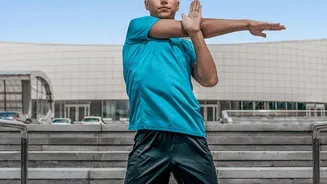
Once your body is warm, the focus shifts to dynamic stretching and mobility work. Unlike static stretching, where you hold a position, dynamic stretching involves actively moving your muscles and joints through their full range of motion. This is crucial before a workout because it improves mobility and enhances neuromuscular coordination without reducing muscle power, which some studies suggest can happen with prolonged static holds before activity. Examples include leg swings, arm circles, walking lunges with a twist, and hip openers. These movements lubricate the joints and prepare them for the specific angles and ranges they will experience during the workout.
Phase 3: Specific Activation
This is where the warm-up becomes truly tailored to your workout. The goal is to perform movements that are identical or very similar to your main exercises, but at a much lower intensity. If you're preparing for a day of heavy squats, this phase would include bodyweight squats or squats with an empty barbell. If you're going for a run, it could involve running drills like butt kicks and high knees to activate the hamstrings and hip flexors. For an upper-body day, you might do push-up variations or use light resistance bands to mimic pressing and pulling motions. This specific preparation activates the precise muscle groups and motor patterns you'll rely on, leading to better performance and reduced injury risk.
Putting It All Together: A Sample Plan
Let's apply this to a full-body strength training workout. A well-structured 10-minute warm-up might look like this:
General Warm-Up (3 minutes):
- 1 minute of light jogging or jumping jacks.
- 1 minute on a stationary bike or rower.
- 1 minute of high knees and butt kicks.
Dynamic Mobility (4 minutes):
- 10 forward leg swings on each leg.
- 10 side-to-side leg swings on each leg.
- 10 arm circles forward and backward.
- 5 inchworms to a cobra stretch.
- 10 walking lunges with a torso twist.
Specific Activation (3 minutes):
- 15 bodyweight squats to prime the lower body.
- 10 glute bridges to activate the posterior chain.
- 10 resistance band pull-aparts to prepare the shoulders.