






A Day Longer Than a Year?
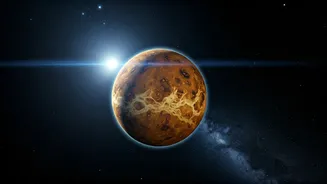
It sounds impossible, but the science is clear. On Earth, we have a simple rhythm: our planet spins on its axis once every 24 hours (a day) and completes an orbit around the Sun every 365 days (a year). On Venus, this relationship is flipped on its head.
A single year on Venus—the time it takes to orbit the Sun—is about 225 Earth days. However, the time it takes for Venus to complete one full spin on its axis, known as a sidereal day, is a mind-bogglingly slow 243 Earth days. This means that on Venus, a day is nearly 18 Earth days longer than a year. If you were born on Venus, you'd celebrate your first birthday before you even lived through your first full day. This counter-intuitive fact makes Venus a true outlier among the planets in our solar system.
Why Is Venus So Incredibly Slow?
The question of why Venus spins so slowly has puzzled scientists for decades. Unlike the fast-spinning gas giants or even our own relatively brisk Earth, Venus barely rotates at all. The leading theory points to its incredibly thick and heavy atmosphere. Venus's atmosphere is about 90 times denser than Earth's, creating surface pressure equivalent to being nearly a kilometre deep in our ocean. Scientists believe that this super-dense atmosphere, moving at high speeds in the upper layers, creates a powerful tidal drag on the solid planet beneath it. Over billions of years, this atmospheric friction has likely acted as a massive brake, slowing the planet’s rotation down to its current crawl. Some theories also suggest that a massive ancient impact could have dramatically altered its spin, but the atmospheric braking model is the most widely supported explanation for its leisurely pace.
To Make It Weirder, It Spins Backwards
As if a day longer than a year wasn't strange enough, Venus also has what's called retrograde rotation. While most planets in the solar system, including Earth, spin counter-clockwise on their axis, Venus spins clockwise. If you could stand on its surface, you would see the Sun rise in the west and set in the east. Only Venus and Uranus have this backward spin. This unique characteristic further complicates our understanding of a 'day.' Again, a colossal impact in its distant past may have literally knocked it into a reverse spin, or it could be the result of a complex gravitational tug-of-war between the Sun and its thick atmosphere over eons. This backward motion is a crucial piece of the puzzle in understanding the planet's bizarre timekeeping.
Sunrise to Sunrise: A Different Kind of Day
This is where things get even more interesting. Because Venus is rotating backwards very slowly while it orbits the Sun, the length of a solar day—the time from one sunrise to the next—is different from its rotational period. The combination of its 225-day year and its 243-day backward spin results in a solar day that lasts about 117 Earth days. So, while one full 360-degree turn takes 243 Earth days, you’d only have to wait 117 days for the Sun to return to the same spot in the sky. This means Venus actually has about two sunrises and sunsets per year, even though a single rotational day is longer than a year. It's a perfect example of how planetary mechanics can create outcomes that defy our everyday intuition.
Our Toxic, Runaway Greenhouse Twin
The strange rotation is just one of many extreme features that define Venus. Often called Earth's “twin” because of its similar size and mass, it couldn't be more different in reality. Venus is a hellscape, the hottest planet in the solar system with surface temperatures averaging 465°C—hot enough to melt lead. This is due to a runaway greenhouse effect caused by its atmosphere, which is composed almost entirely of carbon dioxide with clouds of sulphuric acid. The planet is a cautionary tale of what can happen when a greenhouse effect spirals out of control. Its slow, backward rotation and scorching environment make it one of the most inhospitable yet fascinating places imaginable, a true 'evil twin' to our own world.