








The Global Hunt for Moving Rocks
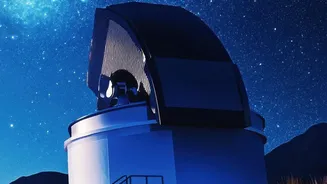
Scientists are constantly scanning the night sky in a global effort known as planetary defence. Using powerful ground-based telescopes, like those in Hawaii and Arizona, they take multiple images of the same patch of sky minutes apart. They then use sophisticated
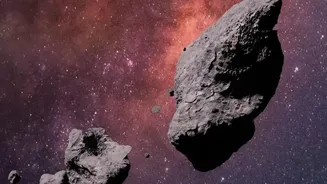
software to look for any 'dots' that have moved relative to the fixed background of stars and galaxies. Once a potential Near-Earth Object (NEO) is flagged, its details are sent to the Minor Planet Center, a global hub, so other observatories can confirm the finding and begin tracking it. This rapid follow-up is crucial because an asteroid’s visibility can change quickly. Through this process, we have catalogued thousands of NEOs, keeping a special eye on those classified as Potentially Hazardous Asteroids (PHAs) based on their size and proximity to Earth's orbit.
Size, Shape, and Shine
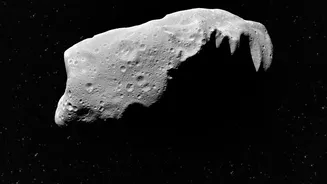
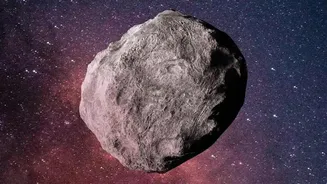
One of the most straightforward factors in detection is an asteroid's physical properties. Larger asteroids are, unsurprisingly, easier to spot from farther away because they reflect more sunlight. An object the size of a mountain can be tracked decades in advance, while one the size of a car might only become visible when it's uncomfortably close. Compounding this is the asteroid's 'albedo', or how reflective its surface is. Many asteroids are made of dark, carbonaceous materials, making them as dark as asphalt or a lump of coal. This means even a relatively large object can be incredibly faint and difficult for telescopes to pick up against the blackness of space.
The Perils of a Sunward Approach
Perhaps the biggest blind spot in our planetary defence is the Sun. Ground-based telescopes can only operate at night, scanning the sky away from the Sun's glare. If an asteroid's orbit causes it to approach Earth from the direction of the Sun, it is effectively invisible to us. The brilliant light of our star simply washes out the faint reflected light from the incoming rock. This is precisely what happened with the 2013 Chelyabinsk meteor, a 20-metre rock that exploded over Russia with no prior warning; it arrived from the daytime sky. This 'daylight blind spot' is a significant challenge that scientists are actively working to overcome.
Orbital Paths and Blind Spots
An asteroid's path, or trajectory, is another critical element. Some have long, looping orbits that bring them into our field of view only once every few years, limiting opportunities for observation. Furthermore, our detection network has geographical limitations. Most of our best survey telescopes are located in the Northern Hemisphere, creating gaps in coverage of the southern sky. Weather, atmospheric conditions, and even the phase of the Moon can also interfere with observations, creating temporary blind spots. Even when an object is detected, determining its precise trajectory requires multiple observations over time to calculate if it poses a genuine threat.
The Future of Seeing Sooner
The good news is that technology is constantly advancing to close these gaps. The Vera C. Rubin Observatory in Chile will soon begin scanning the entire visible sky every few nights, drastically increasing our detection capabilities. More importantly, space-based telescopes are being developed to overcome our ground-based limitations. NASA's NEO Surveyor and ESA's NEOMIR missions are infrared space telescopes designed to spot asteroids by detecting the heat they emit rather than the sunlight they reflect. Crucially, they will be positioned to look for objects in that dangerous solar blind spot, providing a much more comprehensive view of our cosmic neighbourhood and giving us the advance warning we need to protect our planet.