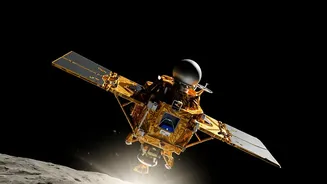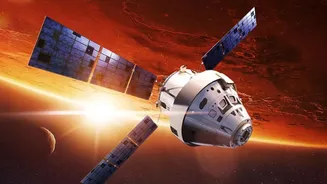







The Japan Aerospace Exploration Agency (JAXA) has begun one of its most ambitious quests yet. Its Martian Moons eXploration (MMX) probe is now on a five-year odyssey to solve a lingering mystery at the heart of our solar system.
An Enduring Martian Mystery
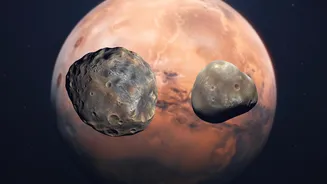
Mars has two small, misshapen
moons, Phobos and Deimos, but their origin has long been debated by scientists. There are two leading theories: either they are asteroids captured by Mars's gravity, or they are the scattered remnants of a colossal impact on a young Mars, similar to how our own Moon may have formed. The MMX mission’s primary goal is to settle this debate once and for all. By studying the moons up close and, crucially, bringing a piece of Phobos back to Earth, scientists hope to learn not just about Mars, but about how planetary systems form and how essential materials like water might have been distributed in the early solar system.
The Five-Year Plan
The mission's 'five-year' timeline reflects the immense challenge of interplanetary travel and exploration. Having launched in October 2026, the MMX spacecraft will spend about a year travelling to Mars, with arrival expected in August 2027. Once there, it won't be a quick visit. The probe will spend roughly three years in the Martian system, carefully studying both Phobos and Deimos. This long observation phase is critical for mapping Phobos, understanding its geology, and identifying a safe and scientifically valuable site to collect a sample. The journey home will begin in 2030, with the precious cargo scheduled to land in Australia in 2031.
The First Sample From a Martian Moon
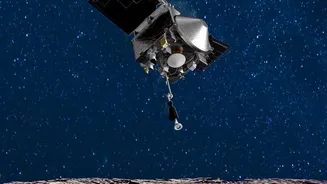
The centrepiece of the mission is the sample return—the first-ever from the Martian system. JAXA has built on the success of its Hayabusa and Hayabusa2 missions, which returned samples from asteroids. MMX will land on Phobos at least once to collect more than 10 grams of regolith, or surface soil. To do this, it is equipped with two sampling systems: a coring device to drill about two centimetres into the surface and a pneumatic system that uses pressurised gas to blow material into a collection container. This complex manoeuvre will take place in the extremely low gravity of Phobos, a significant engineering challenge.
An International Effort
While led by JAXA, the MMX mission is a global collaboration. NASA has contributed a key scientific instrument called MEGANE, a spectrometer that will analyse the elemental composition of Phobos to help determine its origin. The German (DLR) and French (CNES) space agencies have jointly developed a small rover named Idefix. This rover will be deployed onto Phobos before the main spacecraft lands. It is designed to operate for about three months, exploring the surface and providing ground-level data to help mission scientists choose the final sampling location. The European Space Agency (ESA) is also contributing, primarily by providing deep space communication support.