




A Telescope on a Global Scale
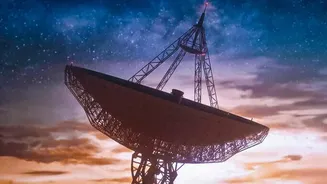
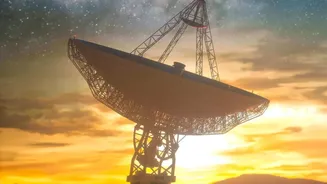
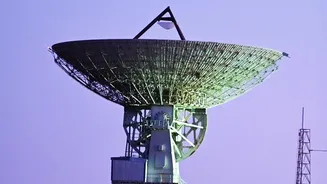
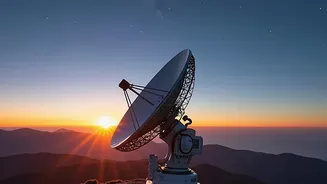
The Square Kilometre Array isn't a single telescope but a massive, international effort to build the world's largest and most sensitive radio observatory. Split between two remote desert locations in South Africa and Western Australia, the project combines
thousands of dish antennas and over a hundred thousand 'Christmas tree-shaped' antennas. The name comes from its ultimate goal: to create a total collecting area of one square kilometre. Managed from its global headquarters in the UK, the SKA is one of the most significant scientific enterprises of the 21st century, designed to tackle fundamental questions about the universe.
Peering into the Cosmic Dark Ages
To understand the SKA's mission, we must go back to the universe's infancy. For a few hundred million years after the Big Bang, there were no stars or galaxies. This period is known as the Cosmic Dark Ages. The universe was filled with a vast, neutral fog of hydrogen gas, and there was no starlight to illuminate it. The critical chapter of cosmic history—the moment the first stars ignited and ended these dark ages—has remained largely invisible to us. This era, known as the Cosmic Dawn, is precisely what the SKA is designed to explore.
Why the First Stars Are So Important
The first stars were not like our Sun. They are believed to have been colossal, hundreds of times more massive, and lived short, violent lives. In their fiery furnaces, they forged the first heavy elements—everything beyond hydrogen and helium. When they exploded as supernovae, they seeded the cosmos with the raw materials necessary for future generations of stars, planets, and eventually, life. These pioneering stars fundamentally transformed the universe, heating the cold hydrogen gas and burning away the cosmic fog in a process called the Epoch of Reionization. Studying them is key to understanding how the structured, luminous universe we see today came into being.
Listening for an Ancient Echo
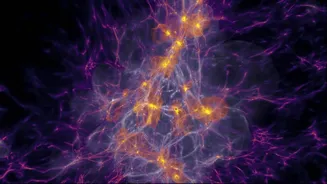
So, how do you see stars that burned out over 13 billion years ago? You don't look for their light directly. Instead, the SKA listens for the effect they had on the hydrogen fog around them. The first stars emitted powerful ultraviolet radiation that carved out bubbles of ionized gas within the neutral hydrogen. The SKA's low-frequency antennas in Australia are specifically designed to detect the faint radio signal emitted by the neutral hydrogen gas before it was ionized. This signal, known as the 21-centimetre line, has been stretched by the expansion of the universe to much longer wavelengths, which is why a radio telescope is needed. By mapping the contrast between the neutral hydrogen and the ionized bubbles, astronomers can create a 3D picture of how the first stars and galaxies lit up the universe.
The Technological Edge for Discovery
Detecting this whisper from the dawn of time is an immense technical challenge. The 21cm signal is thousands of times fainter than the radio noise from our own galaxy and other cosmic sources. This is where the SKA's sheer scale becomes its greatest strength. Its huge collecting area gives it unparalleled sensitivity, allowing it to pick up signals far too weak for any other instrument. Furthermore, the project requires immense computing power to combine the data from thousands of antennas and filter out the foreground noise to isolate the ancient signal. This combination of sensitivity, scale, and advanced data processing makes the SKA uniquely capable of opening this new window onto the early universe.