


The Cosmic In-Betweeners
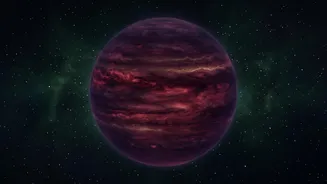
So, what exactly is a brown dwarf? Think of it as an object caught in the middle. They are more massive and hotter than giant gas planets like Jupiter, but fall short of the mass needed to become a true star. The generally accepted mass range for a brown dwarf is between
13 and 80 times the mass of Jupiter. Anything below that is considered a planet or a 'sub-brown dwarf', and anything above it has enough gravitational force to ignite and become a star. Because of this 'in-between' status, they are often called 'failed stars'. They form from the same collapsing clouds of gas and dust that create stars, but they never accumulate enough material to kickstart the engine that makes a star shine.
Too Cool for Stardom
The defining characteristic of a star is its ability to sustain nuclear fusion in its core, specifically turning hydrogen into helium. This process releases a tremendous amount of energy, which is why stars are so hot and bright. Brown dwarfs, however, don't have enough mass to create the intense core pressure and temperature required for sustained hydrogen fusion. They are massive enough to ignite the fusion of a heavier isotope of hydrogen called deuterium, but this is a much less energetic process that doesn't last long. After they burn through their initial deuterium supply, which might take a few million years, brown dwarfs simply cool down for the rest of their existence, slowly fading over time.
Not Quite a Planet
If they're not stars, are they just really big planets? Not exactly. The debate among astronomers continues, but there are two key distinctions. The first is formation. Planets are generally thought to form from the accretion disk of leftover material orbiting a young star. Brown dwarfs, on the other hand, form in isolation through the gravitational collapse of a gas cloud, just like a star does. The second difference is that ability to fuse deuterium. Objects above roughly 13 times Jupiter's mass can briefly fuse deuterium, setting a theoretical dividing line between a giant planet and a brown dwarf. However, this isn't a perfect system, as determining an object's origin story and whether it's fusing deuterium can be incredibly difficult from light-years away.
A Spectrum of Identities
This is where the classification challenge really becomes clear. The temperature of brown dwarfs varies dramatically. Younger, more massive ones can have surface temperatures of over 2,200 degrees Celsius, making them appear similar to cool, red M-type stars. But as they age and cool, their temperatures plummet. Astronomers have found 'Y-type' brown dwarfs that are cooler than a campfire, with some even approaching human body temperature. In fact, recent discoveries have revealed brown dwarfs so cold and faint that they were initially mistaken for extremely distant galaxies. This enormous range in temperature and mass means there is a huge overlap in characteristics with both the smallest stars and the largest planets, making a simple label almost meaningless.
What Webb Is Now Revealing
Powerful new instruments like the James Webb Space Telescope (JWST) are revolutionising our view of these cosmic oddities. Peering into the infrared spectrum, where brown dwarfs glow brightest, Webb is finding objects that push the very boundaries of how small a 'star-like' object can be. Recent observations in the star cluster IC 348 have uncovered free-floating brown dwarfs with masses only two to four times that of Jupiter. Finding objects this small that formed on their own, rather than around a parent star, challenges current theories of star formation. In a further twist, Webb even found evidence that one of these tiny brown dwarfs may have a disk of material around it, suggesting that a planetary system could form around an object that is itself the size of a giant planet.