




The Fiery Problem of Coming Home
Any object entering an atmosphere from space is moving at incredible speeds. For a returning spacecraft, this can be over 28,000 kilometres per hour. At that velocity, compressing the air in front of the vehicle generates immense heat—hot enough to melt
most metals in seconds. For this reason, all re-entry probes and capsules are equipped with a thermal protection system, or heat shield. Traditionally, these have been rigid, ablative shields that burn away in layers or ceramic tiles that radiate heat. But these rigid shields have a fundamental limitation: they must be small enough to fit inside the protective nose cone, or fairing, of the rocket that launches them. This size constraint directly limits the size and weight of the payload that can be landed.
An Inflatable Solution Takes Shape
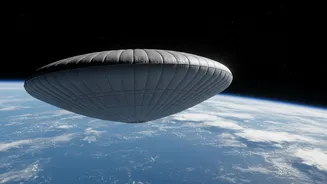
Enter the Hypersonic Inflatable Aerodynamic Decelerator (HIAD). The concept is as elegant as it is revolutionary: a heat shield that launches in a tightly packed bundle and inflates to its full size just before it's needed. This allows for an aeroshell that is much larger in diameter than the rocket fairing it launched in. Think of it like a high-tech airbag that acts as a giant brake. NASA has been developing this technology for over a decade, culminating in the highly successful Low-Earth Orbit Flight Test of an Inflatable Decelerator (LOFTID) mission. This test proved that an inflatable shield could survive the extreme heat and forces of re-entry from orbital speeds.
How It Works: More Than Just a Balloon
This is no simple party balloon. The inflatable structure is a sophisticated assembly of stacked rings, called tori, that are woven from synthetic polymer fibers that are, by weight, stronger than steel. This allows the structure to be flexible enough to be folded, yet incredibly strong and rigid when inflated with nitrogen gas. The business end of the shield, which faces the intense heat, is a flexible thermal protection system. The outermost layer is a woven ceramic fabric made from silicon carbide fibers, which can withstand scorching temperatures. Beneath this are layers of flexible insulation that prevent heat from reaching the inflatable structure itself. The entire assembly is designed to work together to decelerate and shield the spacecraft from destruction.
Bigger is Better for Future Missions
The primary advantage of an inflatable heat shield is its potential size. Because it deploys in space, it can create a much larger surface area than a rigid shield. This increased drag is a huge asset, especially when entering thin atmospheres like that of Mars. A larger shield can start slowing the spacecraft down higher in the atmosphere where the air is less dense, leading to a gentler descent with less intense heating. This capability is critical for NASA's future ambitions, including landing the much heavier payloads required for a human mission to Mars. Current systems are limited to landing about one metric ton on the Red Planet; inflatable decelerators could enable the landing of 20 to 30 metric tons.
From Mars to a Sustainable Earth Orbit
The applications for this technology extend far beyond Mars. Inflatable decelerators could be used to land probes on Venus or Saturn's moon Titan, both of which have atmospheres. Closer to home, they offer a path toward a more sustainable space economy. Companies are exploring the use of smaller inflatable shields to return in-space manufactured products, like specialized alloys or optical fibers, from orbit. Another key application is the recovery of reusable rocket components. United Launch Alliance has partnered with NASA to potentially use this technology to recover the valuable main engines of its Vulcan rocket, significantly lowering the cost of access to space.